

Best Dropship Suppliers In South Africa: Verified Shortlist
Compare eight local and cross-border supplier routes for South Africa, then verify their full delivery, parcel, return, and failed-order economics.
The best dropship suppliers in South Africa depend on the product, fulfillment origin, and buyer terms. These eight candidates cover local and cross-border routes, and dropside suits local general products. EPROLO and CJDropshipping support cross-border sourcing. BrandsGateway covers luxury fashion.
WonderPrint and SubStitch make custom goods locally. Printful and Printify offer wider print-on-demand catalogs.
I ran niche-product and print-on-demand Shopify stores and learned to check the parcel and return path before making a buyer promise. This shortlist relies on current official sources, while a sample and delivered order must settle each choice.
Key takeaways
Which dropship suppliers in South Africa are worth checking?
Dropside fits local general stores, while WonderPrint fits gifts and SubStitch fits sportswear. EPROLO and CJDropshipping widen the search, while BrandsGateway, Printful, and Printify serve narrower product types with different delivery and return limits.
Record packaging and blind-shipping confirmation for every route. Use Shopify's supplier guidance when planning the sample and live-order checks.
Dropside has the clearest local general-product fit. WonderPrint and SubStitch cover narrower custom needs. The other five provide cross-border, luxury, or broader POD options with more shipping and return variables.
Record the same facts for every supplier. Note its type and origin. Track the goods and order model.
The record also tracks shipping, returns, open questions, and the next test. Require live sources because screenshots and site badges can't replace them.
Your buyer receives the item, delivery, support, returns, and replacements as one offer. Strong product photos still depend on a sound shipping path. This guide applies those checks to South Africa. Our supplier selection checklist covers the wider checks.
Compare local and cross-border South African supply
Dropship.io Shop Library can add product and store context, but it can't approve any supplier. Legacy exclusions remain outside the shortlist for specific evidence gaps,
- AliDropship: Software doesn't prove one South African fulfillment route.
- SaleHoo: Directory access doesn't prove a listed supplier's stock or destination terms.
- Doba: The current evidence didn't establish a distinct South African route.
- SHEIN: A retail storefront isn't a published outside-store supplier program.
- Spocket: Supplier-level origin, delivery, and returns still vary by listing.
- TeePrint: The current public record didn't prove the required route and remedy fields.
Dropside and two local makers cover South African fulfillment, while five cross-border platforms cover broader or specialist catalogs. All eight publish an official route that can be tested, and the ranking reflects their fit for different operating models.
Here is the shortlist you'll find below,
- Dropside
- EPROLO
- CJDropshipping
- BrandsGateway
- WonderPrint
- SubStitch
- Printful
- Printify
The supplier cards show where each option fits and what remains unresolved.
1. Dropside, best for local general products
Dropside is the best local general-product fit in this list. This South African marketplace syncs supplier products and stock with Shopify. Its local suppliers then ship customer orders within South Africa.
The best fit is a Shopify general store, and its products must already exist in the marketplace. WooCommerce stores are a poor fit, and so are custom-product stores. One return policy also won't cover every supplier, and the entry plan costs R299.99 monthly. It covers 100 products and unlimited orders. Dropside supplies the software.
The acceptable-use page assigns fulfillment to independent suppliers. The merchant still serves the customer. I prefer this route when local stock can support the published delivery terms.
Before launch, get dispatch and packaging terms in writing. Confirm stock updates, returns, and replacements too. Supplier-level variation is the main downside.
2. EPROLO, best for a free cross-border catalog
EPROLO is the best free cross-border catalog here. It links with Shopify and WooCommerce, and it also connects to marketplaces. The South Africa page lists two delivery estimates. DHL Express is listed at 5 to 15 days. Yanwen is listed at 15 to 30 days. Those vendor estimates vary by item and address.
EPROLO suits a merchant exploring a broad catalog. It doesn't charge a monthly software fee, and a local-stock promise is a poor fit. So is a short fixed delivery window, and a local return address also remains unclear.
The site promotes sourcing, branding, and packaging, and quote each service for your exact item. Send one SKU and variant, and add its packed weight and delivery address. Ask about tracking and replacements. Cross-border variation is the downside.
The estimate doesn't state processing time or the return route. Stock can also change before an order.
3. CJDropshipping, best for product sourcing
CJDropshipping is the best fit for product-sourcing help. It has a catalog and sourcing requests. It also handles orders and shipping quotes. Print-on-demand and custom packaging are available.
Its processing guide lists two to three days with inventory. It lists two to five days without stock. Quote shipping for the exact item and South African address.
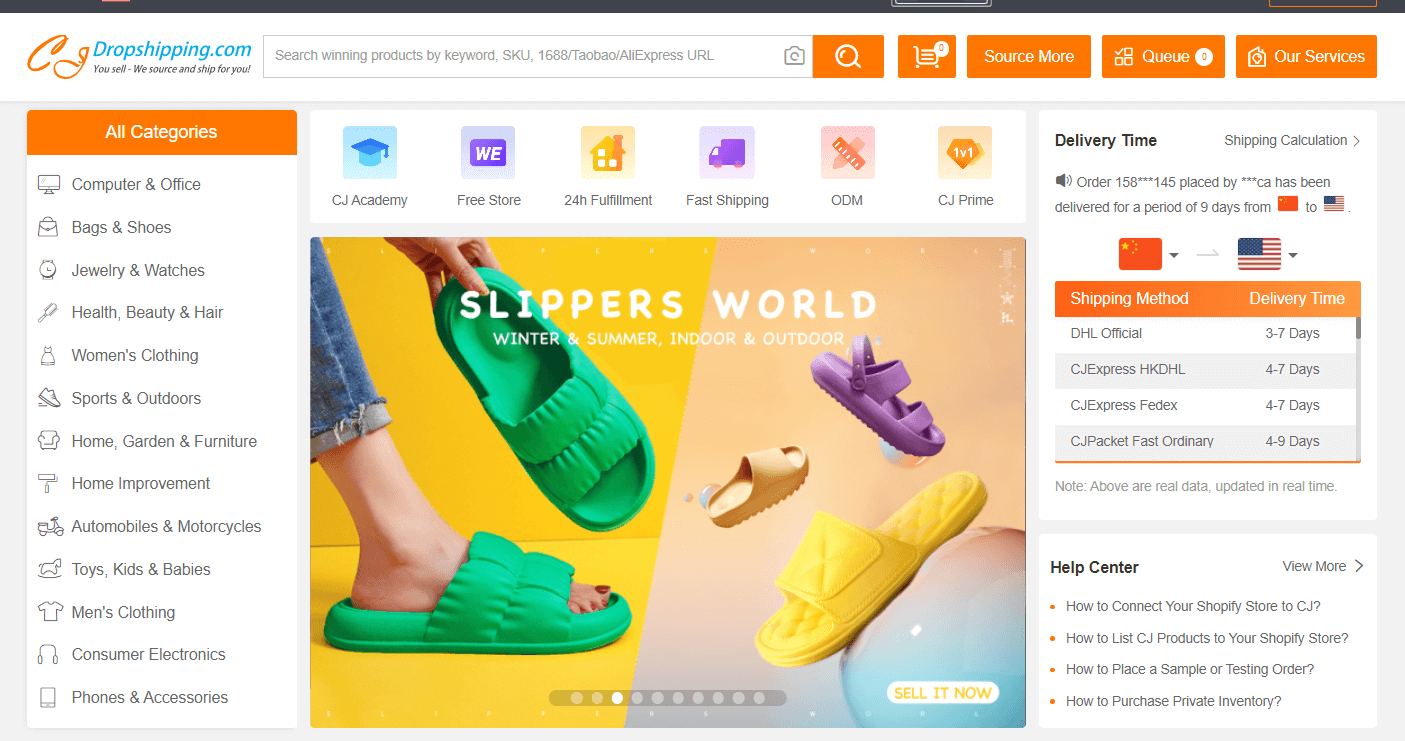
Use CJ when you need help finding or combining products beyond a fixed local catalog. Stores that require local stock or a simple local return route should skip it.
CJ covers delayed, lost, damaged, and wrong orders in its dispute guide. Many returns may go to China, and the store or customer can pay that postage.
I'd test sourcing and delivery on their own. Catalog breadth is useful. It also creates more variation. Stock, freight, packaging, and returns can differ by SKU.
4. BrandsGateway, best for luxury fashion
BrandsGateway is the best luxury-fashion specialist here. It sells designer clothing and accessories and ships worldwide. Orders are listed to dispatch within 24 to 48 hours. Delivery outside the EU is listed at five to seven business days. The site also gives a 14-day return window. Quote the exact South African postcode before publishing that range.
The best fit is a focused luxury store. Its margin must cover software, shipping, and returns, and a budget catalog is a poor fit. So is an early store that hasn't found its buyer, and the entry plan costs €180 monthly. It covers one store, and dropshipping orders have no stated minimum, and shipping adds a base fee and item charge. Check the brand mix before paying. Then check stock and a customer delivery quote.
Confirm the return address and refund timing too. The downside is a high cross-border cost threshold.
5. WonderPrint, best for local gift POD
WonderPrint is the best local gift POD option here. It offers mugs, apparel, bags, and gifts, and the site lists no minimum order. Its workflow is simple. The merchant receives an order. WonderPrint then makes and ships the item.
WonderPrint suits a small local gift catalog, and it also fits basic apparel. You can avoid buying a stock run.
A store that needs a documented API should skip it. The same applies to automatic multichannel routing.
Several public fields remain open. The public pages omit a clear processing range, an integration list, and the full return path.
Get those points in writing, and ask how orders enter the system. Confirm tracking, parcel branding, and defect handling.
Ask who pays for a reprint. Local production earns a sample. Thin public detail is the downside.
6. SubStitch, best for local sportswear
SubStitch is the best local sportswear specialist here. It makes custom sportswear and athleisure, and its products are made in South Africa. One-off orders are accepted. Turnaround is about two weeks after artwork approval and deposit. The range covers cycling, running, swimwear, and gym wear.
The best fit is teamwear, event apparel, or a focused sports brand. Broad general stores and fast commodity tests should use another route, and that production window can't support a quick-dispatch offer.
The no-MOQ model makes a true sample practical, and use it to inspect size and color. Check seams, print placement, and packaging too, and Watch the delivery handoff too. Ask whether repeat orders use the same materials. Confirm how customer addresses enter the order.
Get the defect process in writing. That production window is the clear downside, and delivery time comes after it.
7. Printful, best for global POD integrations
Printful is the best option here for direct POD integrations. It supports store integrations, manual orders, and an API. Products are made after each order, so merchants can skip a normal stock run. South African production isn't promised
Printful's country guidance says it serves most countries. Confirm the exact item and South African address because product access and shipping restrictions can vary.
Alt text: Printful homepage presenting print-on-demand products and fulfillment.
Printful suits a merchant who wants direct ecommerce integrations and manual order support. Local manufacturing isn't the fit, and a local return address isn't promised. One fixed delivery range isn't available either, and Printful's return policy covers damaged or faulty products. It generally rejects buyer-remorse and wrong-size returns, and made-to-order production drives that rule.
Sample the exact garment and print method. Then quote the target postcode. Save the chosen fulfillment location too. Cost, transit time, and returns remain open until you choose the item and fulfillment facility.
8. Printify, best for provider choice
Printify fits merchants who want provider choice. It connects merchants with many print providers and major store platforms.
Shopify, WooCommerce, Etsy, and Wix are included. Manual orders are available too.
Alt text: Printify homepage showing its print-on-demand product catalog.
Printify suits a POD merchant comparing providers. Product and store choices are broad. One quality standard isn't assured. A store that needs one dispatch point should skip it.
Printify's return policy covers timely claims for damage or production faults. It can issue a reprint or refund. Buyer-remorse and wrong-size returns aren't covered.
The provider guide says location, price, shipping, products, and features vary. Treat the network as a discovery route until one provider confirms the exact South African order. Compare two providers for the same item. Then sample the one you plan to keep.
Because providers differ, verify quality, stock, shipping, and replacements for the provider you select.
Prove delivery and support inside South Africa
Verify each supplier with an official-page check, sample, written terms, and live order. Each stage removes weak options before you pay for the next check.
The sequence is,
- Define the product and buyer terms.
- Check the supplier's current official pages.
- Compare a sample with written operating terms.
- Send one live order and update the supplier record.
The four sections below show what to record at each stage.
Fix the product, province, and delivery promise
Define the product and promise before you find dropshipping suppliers. Record the SKU and variant, and add the target postcode and selling platform. Set the top packed cost, and then set dispatch and delivery limits. Include packaging and returns, and this stage prevents a common mismatch, and two-week sportswear can work when it's made to order. It fails under a quick-dispatch promise.
Replace "fast shipping" with a clear limit. Tie that limit to one product and buyer.
Confirm local stock or the cross-border handoff
Check the supplier's current official pages. Open its product, shipping, pricing, and return pages, and check its integration page too. Record each URL and date, and keep published facts apart from your own view. Write "not published" for gaps.
Confirm who fulfills the order. A directory or plugin badge helps with search only.
Ask the fulfiller to confirm stock, shipping, and returns in one written reply. Save it in the supplier record.
Test the parcel, tracking, and return route
Order the exact product you plan to sell. Match the variant and production method, and use a normal customer destination. Save the product page and quote, and keep tracking, parcel photos, labels, and the arrival date.
Compare the item with the listing, and check size, color, material, and finish. Review branding, instructions, and damage protection.
Confirm the return address too. Record any term that changes after payment. An MOQ matters only for your chosen order model.
Repeat the route through a live store order
Send one low-risk live order after the sample passes. Because a sample skips part of the buyer workflow, use the live order to check sync, address transfer, payment, dispatch, tracking, branding, and support. Then update the supplier record with the route and date because supplier terms can change.
I use the first live order as limited proof. Re-check after failures, product changes, or warehouse changes. Price, support, and policy changes also trigger a review.
Compare local and cross-border routes
Local suppliers and overseas platforms suit different stores. Compare the supplier model before you compare products.
Use this table to choose the supplier model before you compare products:
Price the South Africa delivery and return path
A supplier must leave enough money after a South African order. Start with the product quote. Then add freight, fees, route charges, failed deliveries, returns, replacements, and support.
Build one check for the exact item and postcode. Landed cost covers product, freight, and route charges, while ad and failure costs belong in the wider order sum. Use a current quote for the exact product, route, and postcode.
Record these fields for each candidate:
Calculate landed cost as product plus freight plus current destination charges. Then add platform fees and the expected cost of failures and returns. Subtract that decision total from the sale price before you set an ad budget.
Request any missing field in writing. Mark it unresolved until the written answer matches the sample result.
Reject suppliers with weak South Africa evidence
Reject a supplier when its South Africa delivery, return route, or sample can't support your published terms. Reject a cheap quote when the return address is unknown or the sample fails.
Use these stop rules,
- The business identity or role can't be confirmed on a current official page.
- South Africa coverage is missing, contradictory, or available only as a generic worldwide claim.
- The supplier won't confirm stock, processing, packaging, tracking, or returns for the exact product.
- The sample differs materially from the listing or written terms.
- The live order doesn't sync, dispatch, track, or arrive within the range you plan to publish.
- The return or replacement path costs more time or money than the offer can support.
- The supplier changes a material term and won't explain which orders are affected.
I recommend Dropside for a local Shopify store, WonderPrint for local gift POD, and SubStitch for sportswear. The other five serve wider or specialist catalogs. Sample the same written requirement with two options, then keep the supplier whose written evidence matches the delivered order.
FAQ
When should I retest a South Africa supplier route?
Re-check after any change that can affect the buyer. Review products, warehouses, delays, prices, stock, packaging, support, and returns before promotions and at least yearly, then save each URL and date.
Can a local and cross-border supplier back up the same item?
Yes, two suppliers can support one product after both pass the same test. Each sample must meet one spec, so record the supplier and compare packaging, tracking, delivery, defects, and returns.
What if the South African order differs from the sample?
Pause the product and document every difference. Save photos, labels, tracking, the listing, terms, and reply, then require a fix and retest once or reject the option.


