

Why Is Temu So Cheap? The 2026 Answer, Post-Tariff
Temu is cheap because the products are of low quality. In addition, there are factors like loss leader pricing, tax exemptions, and direct sourcing. Temu is not the only source of cheap products. You can source cheap but high-quality products from Dropship.IO. Sign up now and avail your 7-day free trial to find winning products for your dropshipping store!
Temu's low-cost model explains why Temu is so cheap because its marketplace links China-based merchants to buyers, cuts retail overhead, and uses platform-funded discounts. US shoppers also benefited from duty-free treatment on many low-value China parcels until 2025, so that old explanation no longer holds.
I checked the live article against current tariff records. The price tag stopped being enough. I also had to count shipping, duty, and return risk. The reasons below separate lasting savings from those US policy erased.
Key takeaways
Why is Temu so cheap?
Temu keeps prices low through direct sellers, discounts, cheaper production, and online-only retail. A China-based factory can reach a US buyer without a traditional retailer. Temu can then cut the checkout price with coupons or free shipping.
But one old reason no longer applies in 2026. A pre-2025 price screenshot only shows the old policy. The same order costs differently now.
7 reasons Temu products are so cheap
Seven mechanisms explain Temu's prices, but two old explanations need tighter wording in 2026. Here's how the lasting savings compare with the discounts and outdated claims,
- Direct sourcing: China-based merchants reach buyers without a retail chain.
- Loss-leader pricing: Coupons and subsidies reduce the amount paid at checkout.
- Import tax rules: A former US duty break ended in 2025.
- Lookalike products: Simpler parts and specifications can imitate premium designs.
- Manufacturing labor: Lower supplier labor costs can reduce the factory price.
- Digital operations: An online marketplace avoids a physical retail network.
- Digital support: Self-service tools lower the cost of routine buyer questions.
Some of these savings last longer than others. Here's what each one does and where its effect stops.
1. Direct sourcing from manufacturers
Temu lets China-based merchants reach buyers without the wholesaler and retail chain that usually add markups. In its 2025 annual report, PDD Holdings says Temu mainly serves merchants in China and helps them reach consumers.
Temu runs the marketplace, while its merchants sell the items. The shorter route can save money. Logistics partners handle much of the movement.
The shorter route also removes some retail vetting. That leaves you responsible for checking the seller, listing, and item. If you run a store, do those checks before the product reaches a customer.
Each remaining mechanism lowers the supplier's cost or shifts risk to the buyer.
2. Loss-leader pricing to grow fast
Coupons and platform subsidies cut what a Temu buyer pays, even when the seller's listed price stays higher. PDD's annual report confirms that buyers can use company-funded incentives to get merchandise at lower prices.
People often call this loss-leader pricing. The public filings support a narrower point. Temu spends on incentives to attract and keep buyers.
It records those costs based on how each program works. The filings don't show a loss on every discounted order.
Because discounts are a growth choice, they can change overnight. Direct merchant access lasts longer. A coupon ends as soon as Temu cuts its budget or changes the rules. When you test a product, use the normal price after the coupon ends.
3. The 2025 change to import tax rules
Low-value China shipments once received duty-free US entry, but that Temu cost advantage ended in 2025. Before the change, the de minimis rule let qualifying parcels enter without normal import duty. Temu's small direct-to-buyer orders fit that route well.
Ordinary commercial parcels now face duties or fees based on the goods and entry route. That cost lands somewhere between the merchant and the buyer.
The change applies to US orders. Other countries use their own thresholds, taxes, and customs rules. As a result, a buyer elsewhere can see a different landed price.
4. Counterfeit and knockoff items
A cheap lookalike can copy a premium product's shape but leave out its costly materials, testing, and engineering. Fewer features or cheaper materials can lower production cost. A counterfeit finding requires evidence beyond a similar shape. Counterfeiting is an illegal practice rather than a legitimate cost strategy.
Separate evidence sets the compliance boundary. In 2026, the European Commission found a high risk for EU shoppers. They could encounter illegal or noncompliant Temu items.
The examples included some toys and small electronics. The finding supports caution about those groups. It gives no estimate for the whole marketplace.
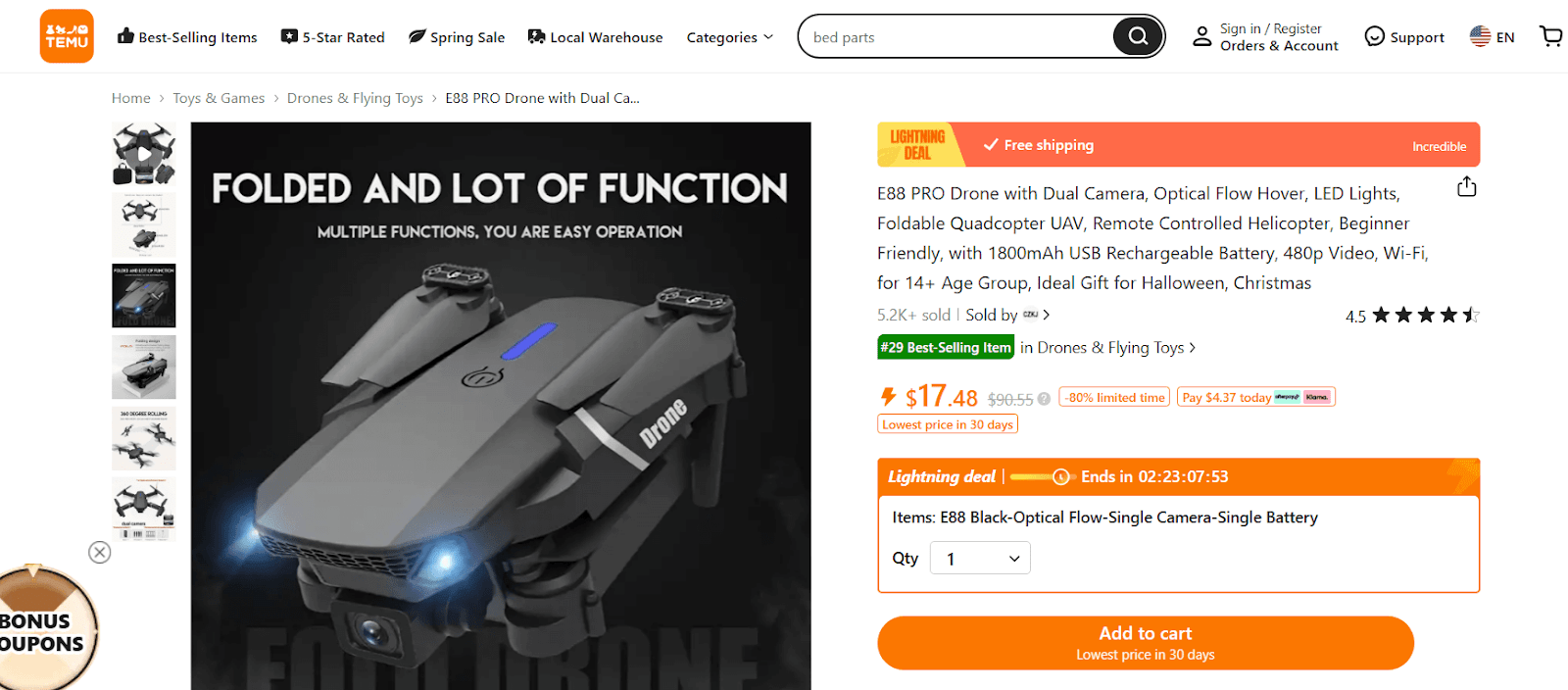
Use these screenshots only to compare how the products are presented. Current prices and proof of infringement need separate evidence. Avoid logos you can't license. Also, sample any generic item before you offer it to customers.
5. Cheap manufacturing labor
Labor can lower the factory price of goods that take more hands to make. Temu doesn't share the labor cost of each product. China's official wage data tracks factory pay by employer type. It gives no product-level cost for a Temu listing.
Labor is only one input. Materials, automation, order volume, energy, tooling, and shipping can matter more for a given product.
Wage data only covers reported pay levels.
A US House Select Committee investigation found in 2023 that Temu reported no independent supplier-audit system. Temu had contract terms that barred forced labor.
6. A digital-only, low-overhead operation
An online marketplace avoids the rent and payroll of a store chain. Temu earns from services tied to outside merchants. Shipping partners move orders.
Temu still pays for its app, ads, support, payments, and shipping. It saves on physical stores. Warehouses, staff, and other systems remain part of the bill.
Those savings matter most against a store network carrying local stock. They matter less when you compare Temu with another online marketplace using a similar merchant model.
7. Digital-first customer service
Self-service help and chat may cut Temu's cost for routine questions. Its current contact page offers 24/7 chat. The help center sorts questions by orders, shipping, returns, and accounts.
This is a plausible cost mechanism rather than a measured saving. Temu keeps its human-agent count private. The live article therefore went too far when it said buyers can't reach a person.
Automation works well for a tracking question. A damaged item, customs hold, or seller dispute can still need human judgment. That handoff is where a low-cost support model can feel slow.
What changed with Temu's pricing in 2026?
The US ended duty-free de minimis treatment for China and Hong Kong goods on May 2, 2025. That change raised the landed cost of affected Temu orders. The old $800 threshold had suited Temu because many purchases were small parcels sent from China to one buyer.
The amount varies by product type and shipping route.
The US later suspended duty-free de minimis treatment for ordinary commercial parcels from all countries. That wider change took effect on August 29, 2025. CBP's suspension guidance still described it as current in February 2026.
I can't predict whether US rates will rise or fall next. A 2026 Federal Register record continued the suspension. So price today's item and route instead of relying on a pre-2025 screenshot.
Use our Product Library to screen price, sales, and revenue, then add duties, shipping, returns, and supplier terms before you commit.
Is it safe to buy from Temu?
Temu is a real marketplace with a refund process, but each listing still carries seller, product, and delivery risk. Its US return and refund policy was updated in April 2026. It covers most returns within 90 days. Electronics may have a shorter window set by the seller.
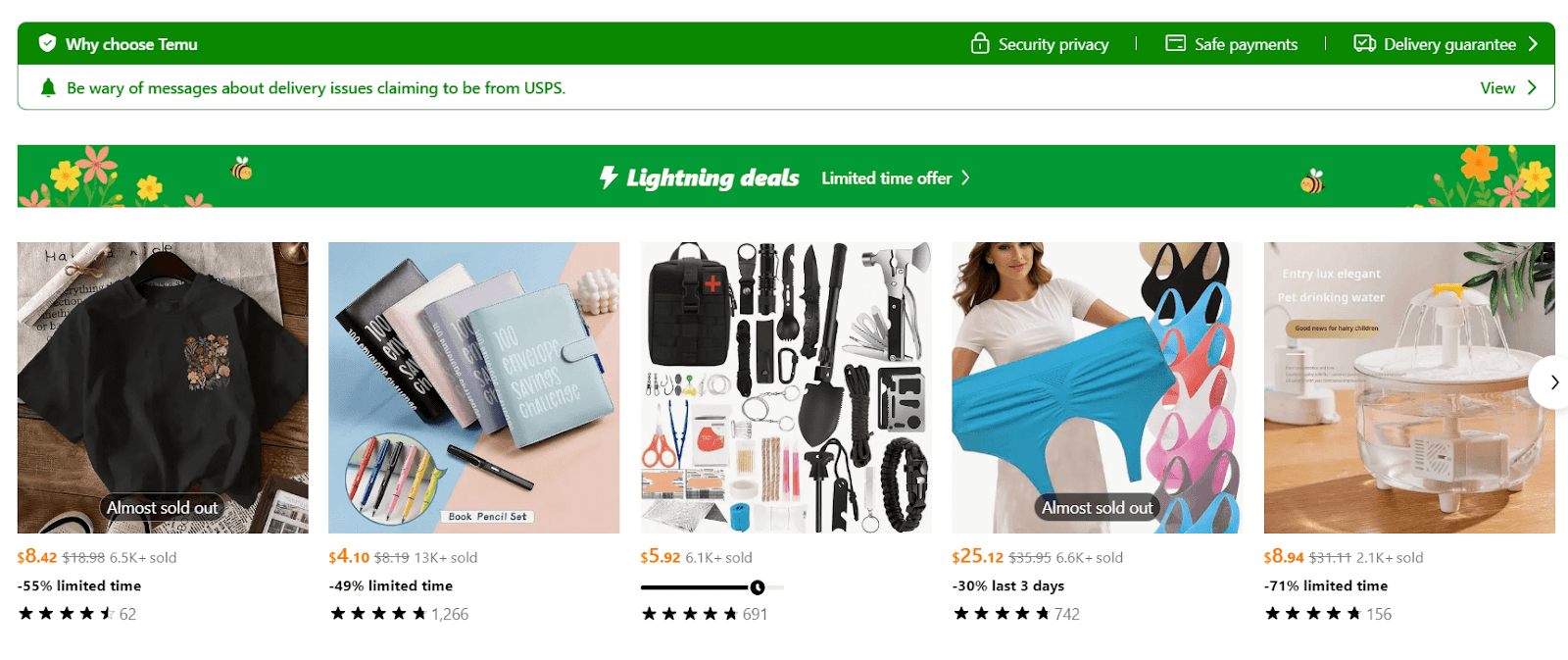
Buyer protection only handles the refund process. Product testing, trademark proof, and the accuracy of your store's claim still rest with you.
The EU's product-risk finding makes toys and small electronics poor blind buys.
I wouldn't put a Temu item in a store after reading reviews alone. First, order the exact variant and photograph what arrives. Then test its key function and run one return before you promise it to a customer.
Is Temu still good for dropshipping in 2026?
Temu is a weak base for dropshipping because its US service only supports retail buying. Its US terms require you to use the service for your own purposes. They bar use for another party's benefit. Temu can also cancel purchases or restrict access after a breach.
The missing program is only part of the problem. Your store needs permission and a repeatable order handoff.
It also needs stock updates, tracking, return ownership, and product rights. Temu doesn't provide that package.
The 2025 duty change makes margins less stable too. A price may work before customs, refund costs, and customer support. Once those costs arrive, it can leave no room for ads or mistakes.
Temu can still help with a personal sample or tiny manual check. A store needs a supplier whose terms and workflow support repeat orders.
For a separate platform-by-platform breakdown, read our Temu-versus-AliExpress comparison.
Can you integrate Temu with Shopify?
Temu has no official Shopify app that sends products, orders, inventory, and tracking between the two systems. You can place retail Temu orders by hand. Manual ordering leaves store data disconnected and may conflict with Temu's terms for third-party use.
CJDropshipping provides a separate route. Its current product-sourcing page accepts a product link, image, target price, and description.
You can use it when an item isn't in CJ's catalog. CJ then looks for a factory that will work with it. If it finds one, CJ adds the product to your account. Shopify and Temu remain unconnected.
This route is closer to connecting suppliers to Shopify. Save the CJ quote and product record. Order a sample, test delivery, and keep the written return terms before listing.
Treat CJ as a new supplier candidate with its own terms. A successful request doesn't preserve Temu's seller, listing, price, or delivery promise.
Risks of dropshipping with Temu
Four risks make a Temu-sourced customer promise hard to control. Review each one before you list a product,
- Impersonation: Fake messages can steal login or payment details.
- Shipping: The delivery estimate changes by product and route.
- Quality: Two units can differ from the listing or each other.
- Support: Your customer waits while you resolve the upstream problem.
These risks often overlap. Your customers hold your store responsible even when Temu or a seller caused the delay.
Scammers impersonating Temu
Fake delivery alerts, gift-card offers, and account warnings can use Temu's name to steal login or payment details. The live Temu page warns buyers about messages that claim to come from USPS.
Check any alert before you act,
- Open the Temu app or type the site address yourself.
- Avoid signing in through a message link.
- Compare its order number with the order shown in your account.
Keep impersonation risk separate from seller-fraud claims when you answer a worried customer. Send customers only the tracking link saved with their order.
Delivery times vary by item and route
Five to ten business days was the live article's general estimate. Temu now gives delivery dates by item, seller, warehouse, and route. Customs can add another delay for a China-origin parcel.
Add the current checkout estimate to your product record before you list. Include your own handling time. Then stop sales if two test orders miss the promise.
A date shown before payment is still an estimate. Set a late-order trigger and name the refund owner. Save the checkout estimate with the order. The customer bought from you and sees you as the responsible seller.
Inconsistent product quality
Temu's seller marketplace can deliver products that differ in materials, finish, safety, or performance. That can happen even when the photos look similar. The risk rises when a listing makes claims you can't check with a sample or document.
Test the product in this order,
- Order two units at different times.
- Compare the dimensions, materials, labels, packaging, and main function.
- Photograph both units.
- Reject the product if either unit misses your store's claim.
Treat the sample as minimum evidence. Later batches can still vary. Repeat the check after any change to the listing, price, or supplier.
Slow or difficult customer service
Upstream support becomes your delay when a Temu order arrives damaged, stalls in transit, or needs a return. Temu's policy gives you a process. But your buyer waits while you gather photos, file the request, send the item, and get a decision.
Make one person responsible for that handoff. Save the Temu order, tracking, delivery promise, product photos, and every customer message in one case file.
If the buyer disputes the card charge first, the problem can become friendly fraud on your store. Refund when your evidence and policy support it. Otherwise, answer the dispute with the records you saved.
FAQ
The remaining questions test whether the low price survives labor, dispute, and ordering risk.
Does Temu use forced or underpaid labor to keep prices low?
The 2023 House report left product-level labor conditions unverified. Require an independent audit that covers pay and working conditions.
What happens if my customer disputes a Temu order?
Your payment processor handles the dispute against your store. You carry the refund, fee, evidence, and account risk while Temu runs a separate return case.
Will Temu's prices keep rising after the tariff change?
Future prices depend on duties, discounts, seller prices, and shipping costs. Reprice the exact product and route whenever one changes.
Can you dropship from Temu without a middleman?
Retail orders must be placed by hand. I wouldn't build a store on that route because Temu offers no official workflow or store link.


