

Minea vs Dropship.io (2026): Which Should You Pick?
Compares Minea’s Meta and TikTok ad-spy workflow with Dropship.io’s sales estimates and Facebook ad research so readers can choose the stronger signal for their budget.
Minea vs dropship comes down to which platform's features, data coverage, and workflow match the job you need done. This 2026 review compares 2 named options across usability, integrations, support, and non-price limits to build the shortlist below.
Key takeaways
What do Minea and Dropship.io actually do?
Minea centers ad discovery, while Dropship.io combines Facebook ad activity with estimated TikTok Shop sales. Both tools help you research products and competitors. Their strongest evidence still answers different questions.
One dashboard starts with what sellers promote. The other can move from Facebook ad spend to TikTok Shop product and shop estimates, so your sales channel should decide which data matters first.
What is Dropship.io and who is it best for?
Dropship.io is a research platform for sellers who want TikTok Shop sales estimates, Facebook ad data, and competitor discovery in one account. Product Library, Shop Library, and Sales Tracker focus on TikTok Shop. Ad Library and Advertiser Library cover Facebook activity. Competitor Research can help identify stores carrying a product.
That mix fits a seller who wants demand and promotion data in one account. Pinterest research is a poor fit. Dropship.io also lacks modeled Shopify revenue because Sales Tracker follows TikTok Shop. Our guide to Shopify sales estimate limits explains why a precise figure still needs a source check.
The workflow moves from a broad search to a saved watchlist. Product Library can sort and filter TikTok Shop items, while Sales Tracker follows selected products and shops over time. The Facebook tools cover ad and advertiser activity. Shopify appears as an import connection and in Competitor Research, so don't mistake that integration for live Shopify sales tracking.
Dropship.io also publishes short tutorials, a university, and a community link. Those resources make the first setup easier. Support speed remains an open question because response times weren't tested for this comparison, so it doesn't decide our verdict.
What is Minea and who is it best for?
Minea is an ad-spy-first research platform with Meta and TikTok ad listings plus product, shop, and brand research. Its paid plans also include AI ad analysis, transcripts, and Magic Search, with higher limits as the subscription price rises.
Minea fits sellers who begin with competitor ads and want to study creatives before building a shortlist. Its public pages disagree on network coverage. The homepage plan table lists Meta and TikTok ads. Meanwhile, pricing-page copy says Pinterest, Snapchat, and TikTok ads are “coming soon.” We wouldn't buy it for Pinterest or Snapchat until the logged-in plan confirms access.
Its workflow starts with ad or product listings, then moves into saved brands, shop notices, AI analysis, and transcripts. That shape helps when the creative itself is the research object. A seller can study how an offer is framed, which ads keep running, and which shops deserve another look before spending on a test.
The drawback is evidence depth. Ad activity can show that a seller keeps paying for reach, yet it can't reveal the margin or conversion rate behind that spend. Minea is useful for finding candidates. It needs a separate demand and unit-cost check before a product earns budget.
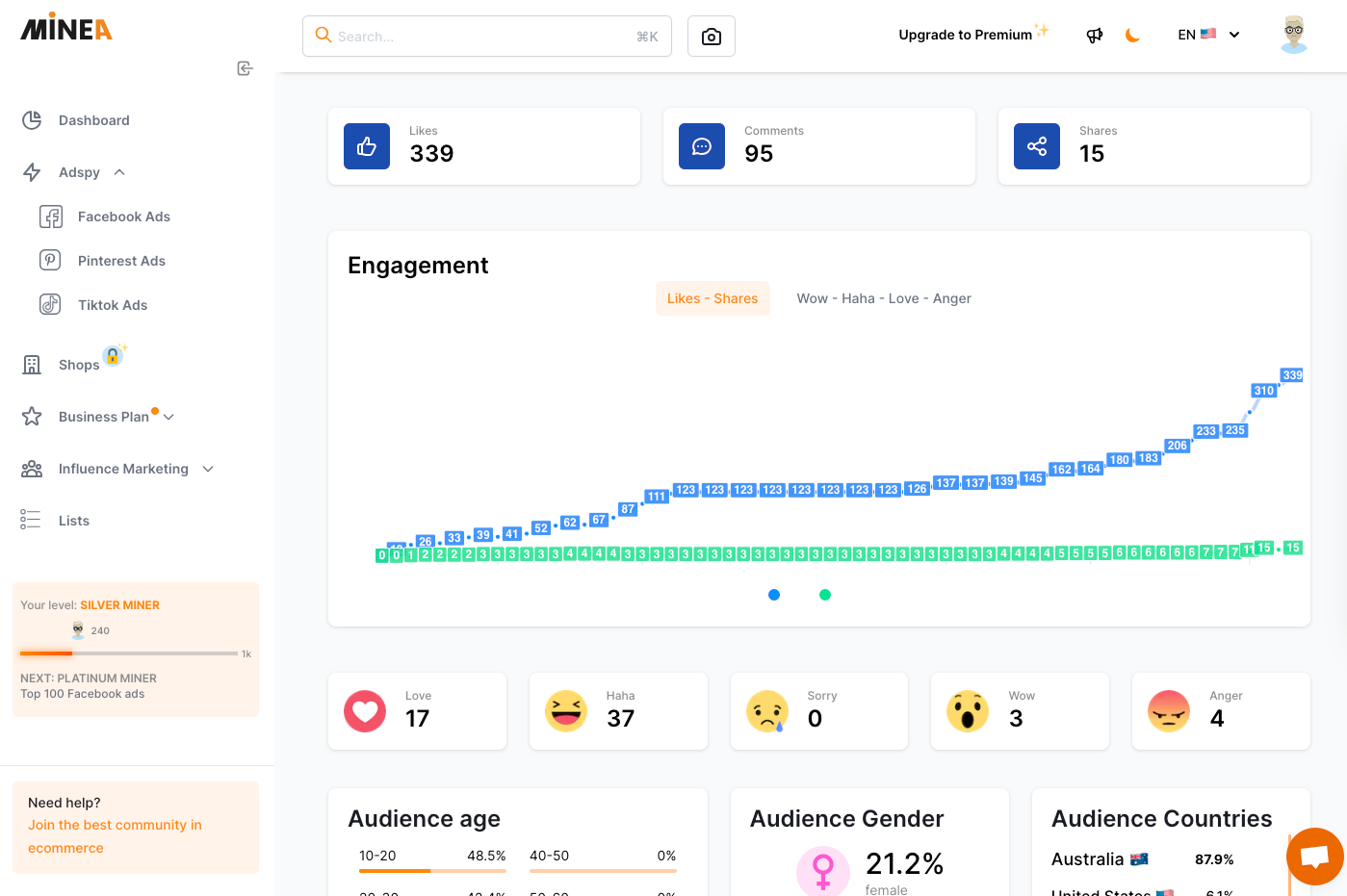
Ad spend vs. real sales: what each tool measures
The Signal-First Decision favors Dropship.io for TikTok Shop demand estimates and Minea for an ad-spy-first research workflow. Start with the decision you need to make, then choose the evidence closest to it.
Ad activity shows that a seller is paying to put a product in front of people. It leaves out conversion rate, refunds, product cost, and profit. A busy ad can point to demand, a failed test, or both.
Tracked marketplace sales sit later in the buying process. Product Library and Sales Tracker estimate TikTok Shop sales from public platform signals. Use those estimates to rank recent traction while keeping them separate from a merchant's private order data.
Dropship.io also covers ads. Its plans include Facebook Ad Library and Advertiser Library credits, plus advertiser tracking. Minea fits ad search and creative review. Dropship.io fits TikTok Shop research beside Facebook ads.
Neither vendor publishes enough detail to reproduce every sales or ranking figure. A product still needs a margin check and a small real-world test before you stock or advertise it.
Once a product reaches your shortlist, calculate return on ad spend with your own selling price, conversion value, and spend. That math answers a profit question neither dashboard can settle.
Minea vs Dropship.io: Plans, features, and access in 2026
Dropship.io and Minea organize access around different workflows. Dropship.io expands product, shop, ad, creator, and tracking capacity, while Minea expands AI analysis, search, brand tracking, and notifications.
Compare the feature category that supports your repeated task. A larger allowance only matters when the current limit interrupts useful research, and it doesn't make the underlying evidence more reliable.
Dropship.io plans
Dropship.io keeps the same core research categories across its main plans and changes how much work each account can complete. Product, Shop, Ad, Competitor, and Creator research remain the main jobs.
The entry plan fits a narrow weekly shortlist. The middle plan suits regular research across several products or niches, while the highest plan is for teams that repeatedly reach tracking and library limits.
Minea plans
Minea changes access through AI, search, brand-tracking, and notification allowances. Its entry plan supports occasional creative analysis, while higher plans expand repeated searches and monitoring.
Choose Minea when ad discovery and creative review drive the workflow. Choose Dropship.io when store activity, product demand, and competitor research need to sit together.
Which should you pick on a tight budget?
Start with Dropship.io when one paid subscription must cover both TikTok Shop demand estimates and Facebook ad research. Its paid entry price is lower, and its current toolset reduces the need for a second subscription during early validation.
Pick Minea first when your weekly routine begins with Meta or TikTok ad discovery and creative analysis. Its Starter plan costs more than Dropship.io Basic, but price alone can't decide the choice if Minea's workflow answers the exact question blocking your campaign.
Plan limits should match the work you actually repeat. Dropship.io Basic already tracks 10 shops and 25 products, which is enough for a focused shortlist. Minea Starter gives 10 AI analyses, 10 transcripts, and 50 Magic Searches per month. If those limits cover a normal week, paying for a larger tier adds capacity without improving the signal.
We'd use the budget in this order:
- Name the decision: Find an advertised idea, estimate sales, or monitor a competitor.
- Match the evidence: Choose the tool that produces the needed signal.
- Start small: Use the lowest plan until a real limit interrupts the work.
A seller without a TikTok Shop research need gets less value from Dropship.io's strongest demand signal. Pinterest users should pause because Minea's own pages conflict. Either channel gap can reverse the recommendation.
Pick Dropship.io first for TikTok Shop plus Facebook research. Pick Minea first when ad discovery is the job you repeat most.
Final thoughts: should you use both?
Use both when Minea adds ad-research depth beyond Dropship.io's combined workflow. The two subscriptions can complement each other. Yet “serious sellers use both” is too broad because Dropship.io already puts Facebook ad research beside TikTok Shop estimates.
The pairing makes sense when you repeatedly find products through Minea and then need a separate TikTok Shop traction check. It can also work when a team wants Minea's creative and brand-monitoring workflow while another person tracks shops and products in Dropship.io.
The second subscription earns its place when the first tool leaves a repeatable question unanswered.
For example, Minea may keep surfacing ads that need a TikTok Shop sales check. Dropship.io users may want a deeper ad-review routine with Minea's saved brands, AI analysis, and transcripts. A vague wish for “more data” isn't enough.
We wouldn't pay for both just to feel more certain. Two dashboards can repeat the same weak clue, and neither replaces supplier checks, contribution-margin math, or a controlled ad test. Add the second tool when you can name the missing channel, signal, or limit it fixes.
If Minea covers the ad networks you need and the extra workflow is worth its monthly cost, keep both. Otherwise, start with the one that matches your next decision and review other Minea alternatives only when a specific coverage gap remains.
FAQ
Is Dropship.io or Minea cheaper?
What's the best alternative to Minea?
Dropship.io is the better Minea alternative when you want TikTok Shop sales estimates beside Facebook ad research in one lower-cost entry plan. Sellers focused on another ad network or deeper creative analysis should choose an alternative that clearly publishes current coverage and plan limits.
Why does Minea pricing look different across sites?
Minea pricing differs across comparison pages because plan names, currencies, billing periods, and included usage limits have changed across product updates. Use the vendor's checkout terms and selected currency for the final payable price instead of relying on an undated third-party table.
Does Minea ad data mean a product is selling?
No, Minea's ad data shows advertising activity rather than a merchant's verified completed sales or profit. Use it to find products worth checking, then validate demand with supplier checks, margin math, and controlled conversion tests.


