

Shein Dropshipping in 2026: Margins, Shipping, Legal
Evaluate Shein dropshipping through current US customs costs, an illustrated margin calculation, product risks, setup steps, and the conditions that make another supplier safer.
Shein dropshipping still looks simple from the storefront. You find a low-priced item, list it, and order it for the customer after a sale. The hard part now comes after checkout.
Import charges can erase the price gap. Shein also controls the parcel and delivery, while you'll need listing assets that you created or licensed.
We've used Alibaba and run our own stores through supplier changes like this one. The lesson stays the same. A catalog price is only one cost.
Popularity offers no proof of safe fit. This guide models a live Shein SKU under the chosen route, and it assumes China origin, US delivery, and a non-postal carrier.
Key takeaways
What is Shein dropshipping?
Shein dropshipping means listing a Shein product in your own store, buying it from Shein after a customer orders, and entering the customer's delivery address at checkout. Shein ships the retail parcel, while your store owns the listing, price, delivery promise, support, and refund decision for the buyer.
This model holds no stock in advance. After a sale, you collect payment and place a retail order with Shein. Your margin is what remains after product, delivery, import, payment, refund, and ad costs. Shein ships the parcel, while your store owns the listing, delivery promise, support, and refunds.
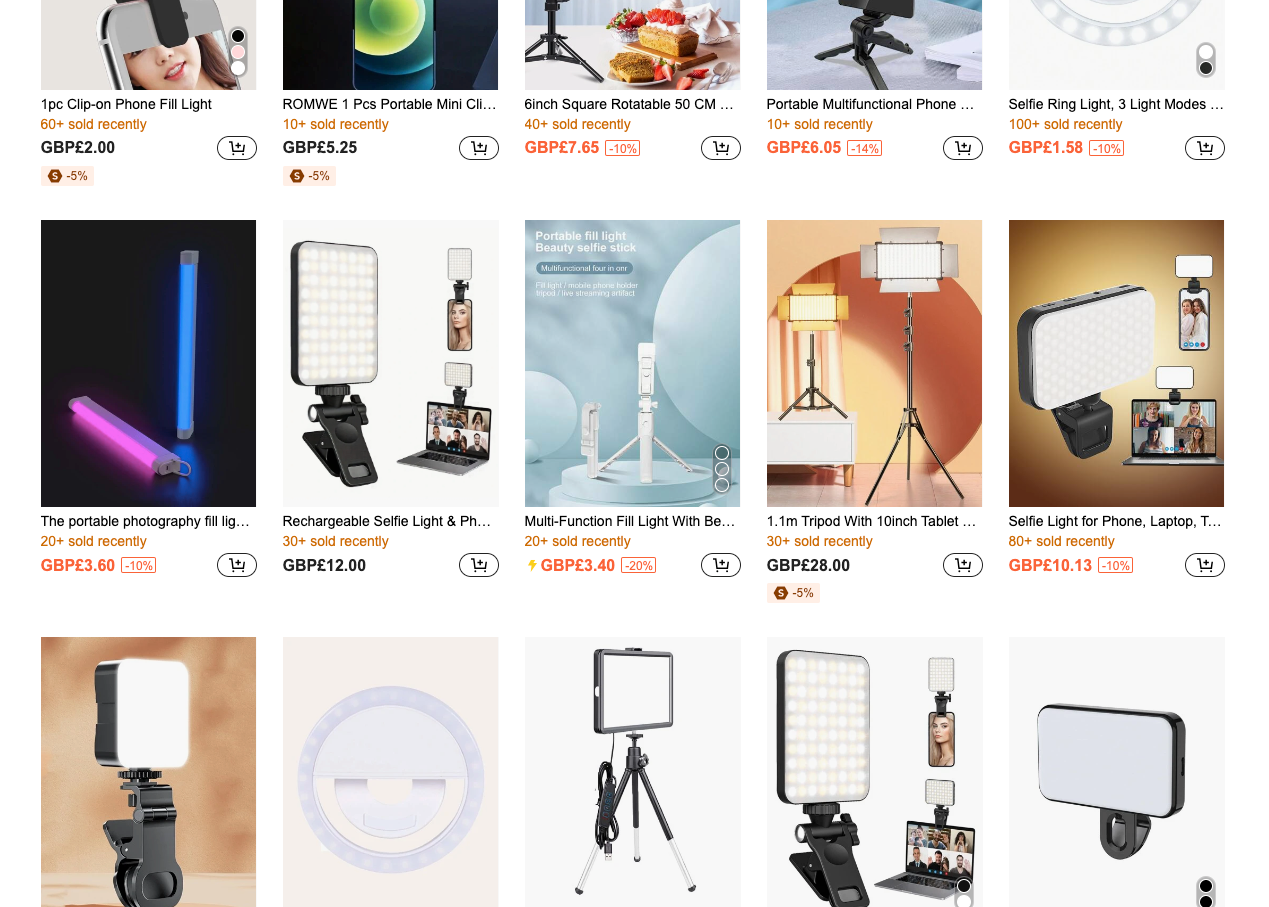
This is a retail sourcing workflow. Shein doesn't publish a dropshipping program, public API, or native store link. Import and order tools are third-party services. Their use doesn't show that Shein approved the store.
The workflow gives you no way to set neutral packaging or reserve stock. Shein also gives you no service-level deal. A parcel may show its brand, original price, or a sale. Your customer will see that as your choice.
Is Shein dropshipping still legal in 2026?
A genuine Shein item can generally be resold in the US, while the listing, customs route, and regulated product still need their own checks. US copyright law's first-sale rule lets an owner resell a lawfully made copy. The rule appears in 17 U.S.C. § 109.
The Copyright Office also describes this resale rule.
The Supreme Court applied it to qualifying copies made abroad in Kirtsaeng. Resale of the item doesn't transfer rights to its photos or listing copy.
The practical checks before listing are,
- Confirm that the item is genuine and lawfully sold.
- Take your own photos and write your own description.
- Present your store and seller relationship accurately.
- Set a stricter evidence rule for toys, electronics, cosmetics, food-contact products, and children's goods.
- Give the carrier accurate value, origin, and product information for customs.
Customs compliance is separate from resale rights. For a direct China-to-US order, ask the carrier or broker to identify the importer of record, tariff codes, entry method, and charges in writing.
Treat this as business guidance. Ask a customs broker or qualified lawyer to review unclear tariff, intellectual-property, labeling, or safety issues.
What changed for US Shein orders in 2025-2026
The biggest change is the suspension of US de minimis duty-free treatment for covered commercial parcels, including China-to-US orders below $800. The suspension took effect on August 29, 2025. Executive Order 14324 set that boundary.
Executive Order 14388 continued it. That order took effect in February 2026.
CBP's non-postal rule routes low-value parcels through Entry Type 11 with duties, taxes, and fees. It isn't duty free.
Shipping and customs timing
AutoDS's current Shein shipping guide gives a range of seven to fourteen business days for standard shipping and three to seven for express. It adds two to four days for formal customs entry, so the carrier quote and tracked sample must set the customer promise.
Our prior Shein shipping guide listed about ten days for standard shipping and seven for express. Those estimates remain useful only as a comparison point.
AutoDS gives newer ranges for both Shein standard and express shipping tiers. Check the live route again before pricing.
Current US duty inputs
CBP's Executive Order 14324 guidance explains the operational treatment. Use the carrier's written quote to price the exact shipment route.
Executive Order 14389 ended the earlier IEEPA fentanyl and reciprocal tariff actions in February 2026. A separate 10% temporary surcharge ran from February 24 until 12:01 a.m. EDT on July 24, 2026, so it isn't included in the September calculation.
The current USTR action took effect that day. It adds a 12.5% Section 301 duty for China. The current HTS exemptions don't cover 6204.43.40.
Use these inputs to model a China-to-US order:
Shein's US shipping page publishes its shipping prices and reported timing. It sets no fixed customs delay. Clearance varies with the shipment data, carrier, checks, and handoff. Base your promise on tracked orders that use the same route.
The lesson behind why ultra-low-cost suppliers like Temu can price so low also applies here. The storefront price shows only part of the cost.
Realistic margins after the de minimis change
A $12.18 Shein dress sold for $29.99 leaves $2.58, or 8.6%, before ads and overhead in this China-to-US non-postal scenario. The actual Shein SKU is a woven women's dress listed at $12.18 and described as 100% polyester. The model assumes China origin, US delivery, standard shipping, and a non-postal carrier. The page doesn't prove origin.
The working code is HTS 6204.43.4030, with a 16% base duty. Material alone can't settle the full code, so a broker must confirm it.
Our estimate adds the current 7.5% China duty under 9903.88.15.
It also adds the current 12.5% forced-labor duty under 9903.05.31. The duty stack is 36%, or $4.38 on the $12.18 customs value.
CBP lists a lowest automated informal entry fee of $2.69. That brings import charges to at least $7.07. Carrier-prepared and express-hub fees can differ.
The full five-input calculation is:
Margin line
Amount
Selling price
$29.99
Product cost
-$12.18
Shipping
-$3.99
Import charges
-$7.07
Payment processing
-$1.17
Return allowance
-$3.00
Remaining before ads and overhead
$2.58
<section class="di-margin" aria-label="Landed-cost calculation for a Shein dress shipped from China to the United States by a non-postal carrier">
<style>
.di-margin{font-family:inherit;color:#172033;border:1px solid #dce4f2;border-radius:14px;overflow:hidden;margin:24px 0}.di-margin h3{margin:0;padding:18px 20px;background:#225aea;color:#fff;font-size:22px}.di-margin__rows{padding:8px 20px 18px}.di-margin table{width:100%;border-collapse:collapse}.di-margin td{padding:11px 0;border-bottom:1px solid #e5eaf2}.di-margin td:last-child{text-align:right}.di-margin tr:last-child td{border:0;background:#eef3ff;padding:14px 8px;font-weight:700;color:#1746b5}.di-margin__note{padding:0 20px 18px;font-size:13px;color:#59657a}@media(max-width:390px){.di-margin h3{font-size:19px;padding:15px}.di-margin__rows{padding:7px 15px 15px}.di-margin td{font-size:14px}.di-margin__note{padding:0 15px 15px}}
</style>
<h3>$29.99 sale: what remains?</h3>
<div class="di-margin__rows"><table><tbody>
<tr class="di-margin__row"><td>Product</td><td>-$12.18</td></tr>
<tr class="di-margin__row"><td>Shipping</td><td>-$3.99</td></tr>
<tr class="di-margin__row"><td>Estimated duties and entry fee</td><td>-$7.07</td></tr>
<tr class="di-margin__row"><td>Payment processing</td><td>-$1.17</td></tr>
<tr class="di-margin__row"><td>Return allowance</td><td>-$3.00</td></tr>
<tr class="di-margin__row"><td>Before ads and overhead</td><td>$2.58 (8.6%)</td></tr>
</tbody></table></div>
<p class="di-margin__note">A carrier or customs broker must confirm the classification, applicable Chapter 99 lines, fees, and importer arrangement for the actual shipment.</p>
</section>
We haven't put this SKU through a broker-backed entry. The tariff lines are an estimate, and CBP has final control over the code.
Express-hub and carrier-prepared fees may differ. A fee above our minimum cuts the margin below $2.58.
We'd reject this SKU at $29.99 unless the carrier confirms lower charges or buyers accept a higher price. This check gives you the answer before paid ads do.
Best products to sell from Shein in 2026
The best Shein products are simple, light, non-fragile items with visible demand signals, enough price room, and no unresolved safety or sizing burden.
The ten product groups are,
- Women's dresses
- Loungewear and pajamas
- Pet products
- Electronic accessories
- Event and party supplies
- Storage and organizational products
- Water bottles
- Kids' toys
- Men's fashion
- Household cleaning products
These ten categories are catalog starting points, but availability alone is weak demand evidence. Compare each SKU by cost room, return risk, demand signals, and work needed before you shortlist it.
1. Women's dresses
Women's dresses have strong catalog depth and visual selling potential, but their sizing and import-duty exposure make them a test-only category.
<section class="dsio-pros-cons" aria-label="Pros and cons of Women's dresses">
<style>
.dsio-pros-cons{font-family:inherit;display:grid;grid-template-columns:repeat(2,minmax(0,1fr));gap:14px;margin:20px 0 24px;color:#172033}.dsio-pros-cons *{box-sizing:border-box}.dsio-pros-cons__panel{border:1px solid #d8e2ec;border-radius:12px;padding:16px 18px}.dsio-pros-cons__panel--pros{border-top:4px solid #21835b;background:#f2fbf6}.dsio-pros-cons__panel--cons{border-top:4px solid #bd3f3f;background:#fff5f5}.dsio-pros-cons h4{margin:0 0 10px;font-size:18px;line-height:1.25}.dsio-pros-cons__panel--pros h4{color:#155f42}.dsio-pros-cons__panel--cons h4{color:#8a2929}.dsio-pros-cons ul{margin:0;padding-left:20px}.dsio-pros-cons li{margin:0 0 8px;line-height:1.5}.dsio-pros-cons li:last-child{margin-bottom:0}.dsio-pros-cons__panel--pros li::marker{color:#21835b}.dsio-pros-cons__panel--cons li::marker{color:#bd3f3f}@media(max-width:640px){.dsio-pros-cons{grid-template-columns:1fr;gap:10px}.dsio-pros-cons__panel{padding:14px 16px}}
</style>
<div class="dsio-pros-cons__panel dsio-pros-cons__panel--pros">
<h4>Pros</h4>
<ul>
<li>Broad catalog depth supports focused silhouette tests.</li>
<li>Visual products give you several original-creative angles.</li>
</ul>
</div>
<div class="dsio-pros-cons__panel dsio-pros-cons__panel--cons">
<h4>Cons</h4>
<ul>
<li>Sizing and fabric expectations can raise returns.</li>
<li>Textile duties can erase a narrow price gap.</li>
</ul>
</div>
</section>
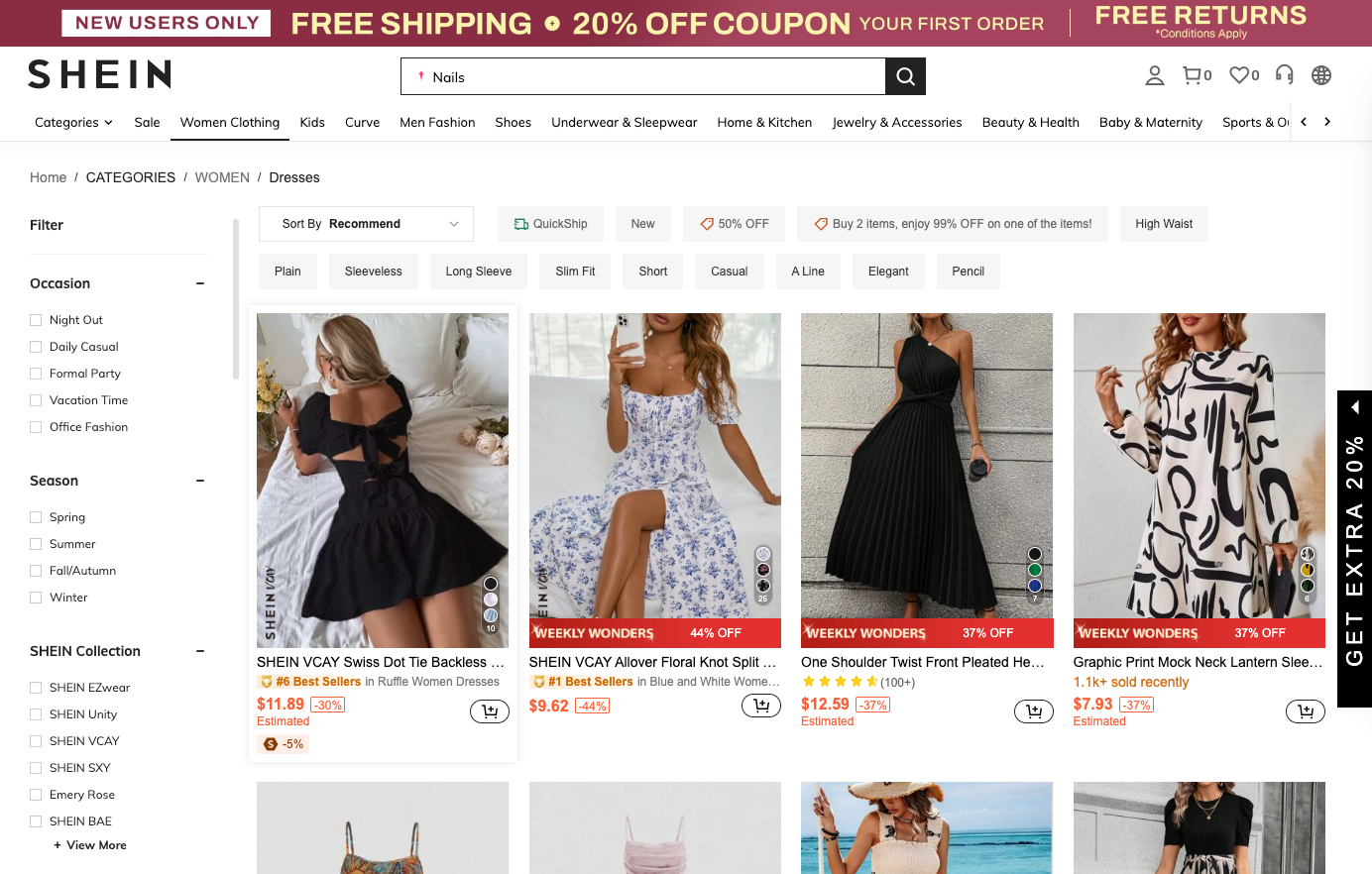
Shein's US dress category shows recent sales counts and a wide price range, which is useful for discovering silhouettes and checking whether a design has current activity. The polyester dress in our margin example may attract several tariff layers from China. Fit, fabric expectations, and color differences can also drive returns.
Choose one design with a clear size chart and fresh reviews. Leave enough room to buy samples in several sizes. A dress fails when the margin needs perfect sizing. It also fails when you lack your own photos and fabric notes.
Keep the first test to one color and two sizes. Buy both and measure them flat. Wash each sample once. Use the results in your own size guide and care notes.
2. Loungewear and pajamas
Loungewear can sell on comfort and gifting, but fabric feel and fit remain hard to communicate without sampling.
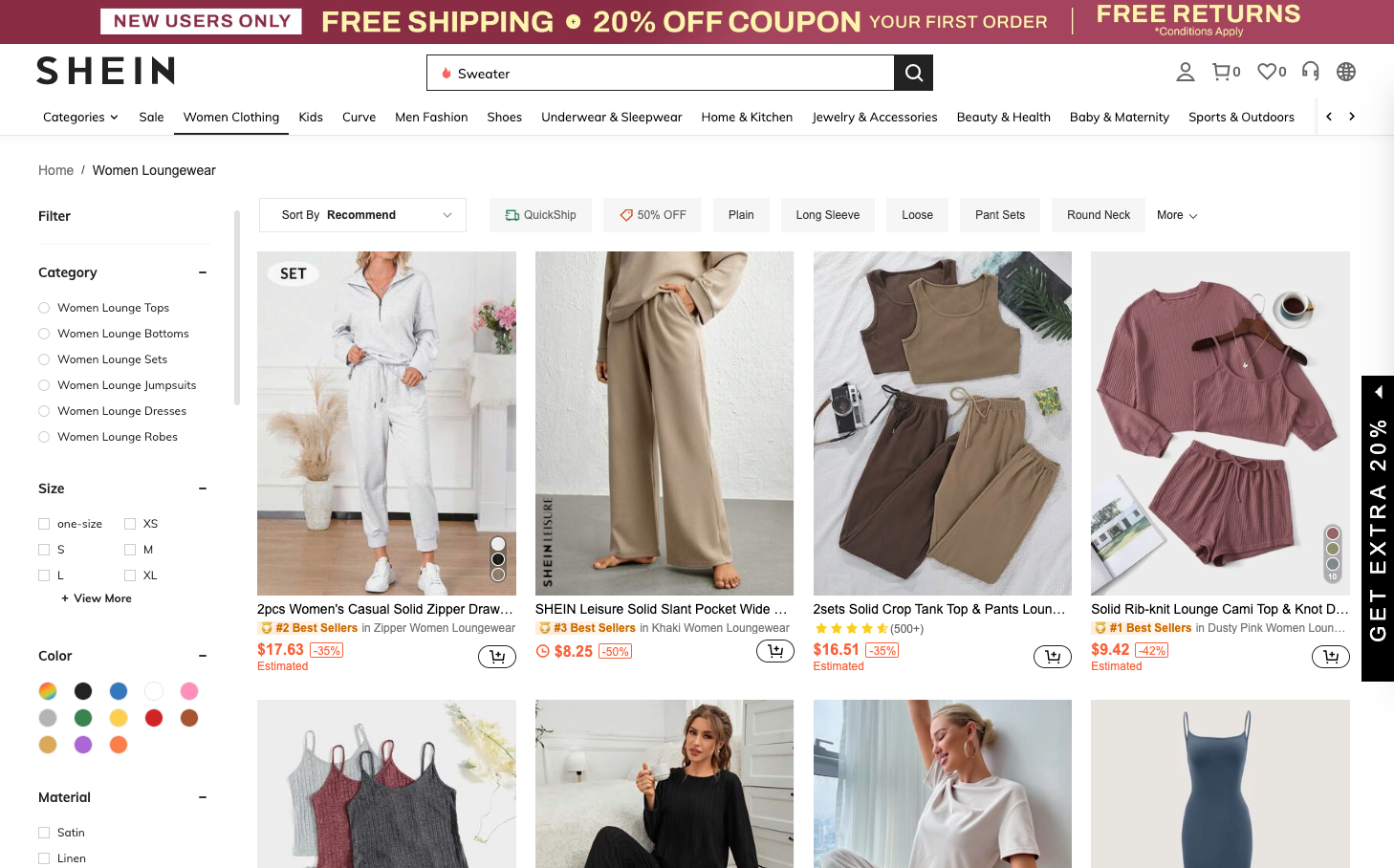
This category can support bundles and seasonal creative. Relaxed fits may also cut some sizing pressure. Softness, opacity, seam quality, and wash performance are hard to judge from a catalog page. Those traits often decide whether a customer keeps the order.
Order and wash-test the exact SKU. Keep the product only if the listing's measurements match the sample and the fabric still feels acceptable after cleaning.
Check the cuffs, waist, seams, and fabric in daylight. Wear the sample for a full evening. Note any heat, itch, or color transfer. These details can shape both the listing and refund plan.
3. Pet products
Non-ingestible pet accessories can be workable when they're simple and size-tolerant, while safety-critical items need stronger supplier evidence.
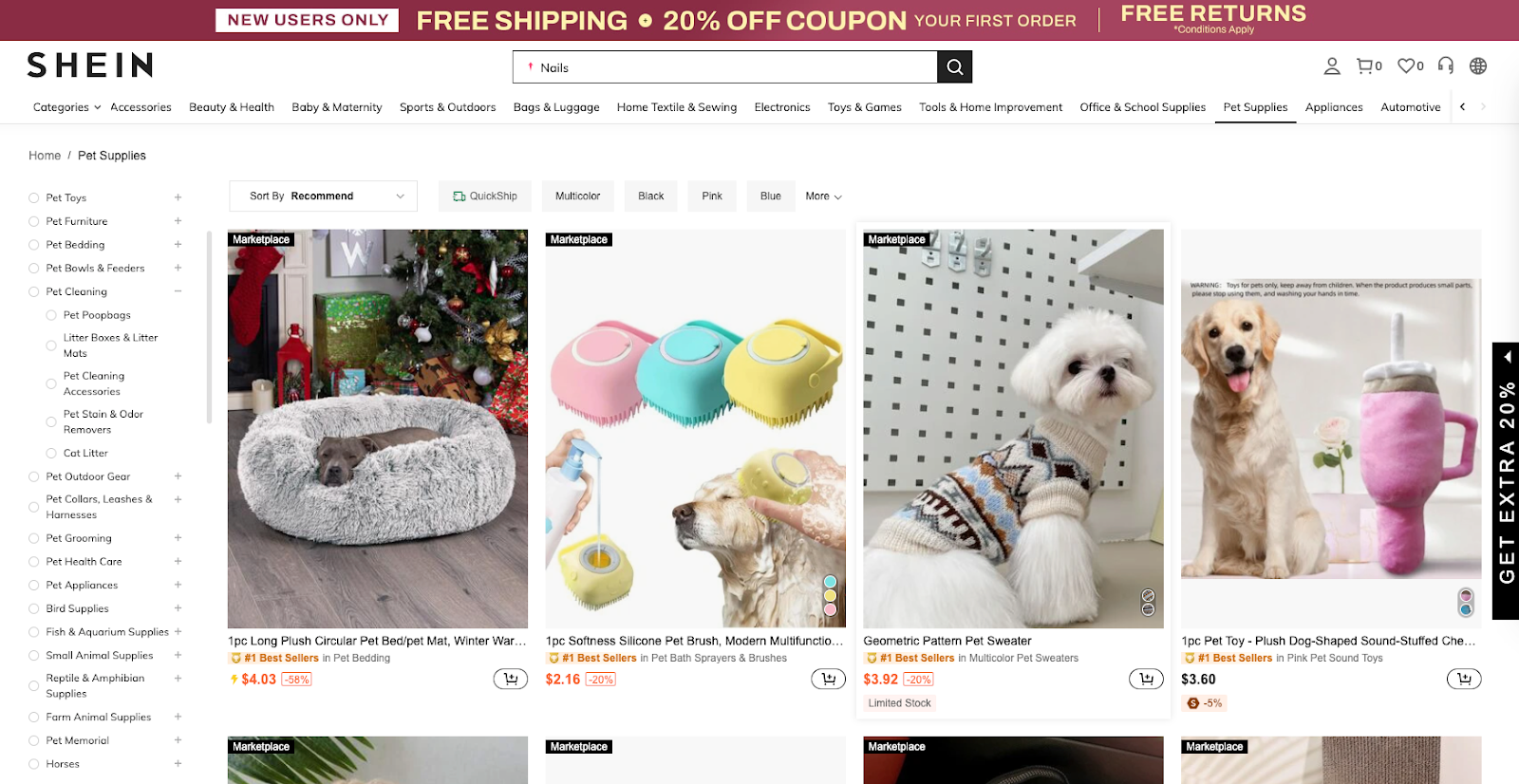
Simple bandanas, storage pieces, and decorative accessories avoid some of apparel's human sizing issues. Harnesses, restraints, feeding items, and chew products carry a different risk because failure or unsuitable materials can harm an animal.
Shortlist only products you can inspect for seams, small parts, materials, and realistic use. Reject any item whose safety depends on an unsupported load, durability, or material claim.
Try the item with the pet size shown on the page. Watch how clips and seams react to normal pull. Stop the test if parts bend or detach. A cute design can't offset a weak build.
4. Electronic accessories
Passive electronic accessories may fit a test, but powered products and protective claims add failure, compatibility, and compliance risk.
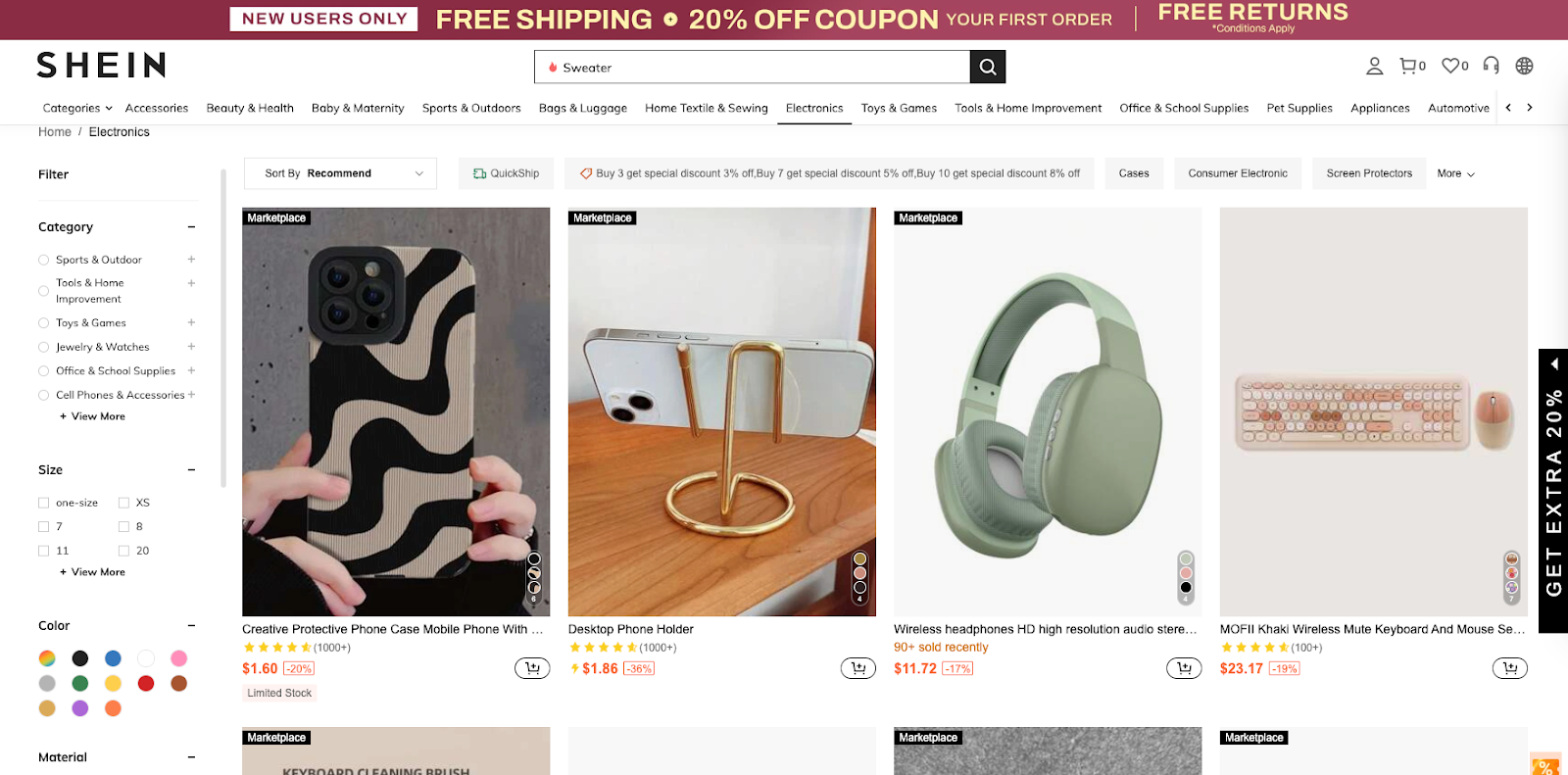
Passive phone stands, cable organizers, and cases are easy to test. Chargers, power banks, and impact claims need more proof. Model fit still changes fast. A stale listing can drive many support requests.
We'd shortlist non-powered accessories for one current device family and verify the fit ourselves. We'd reject mains-powered products, batteries, or safety claims without test documentation and a supplier route built for them.
Name each supported model in the listing. Test the case with a real phone. Check every port, button, lens, and charging pad. Remove the SKU when a new model makes the fit unclear.
5. Event and party supplies
Event supplies can work when they're lightweight and date-flexible, but one late parcel can make the entire order worthless.
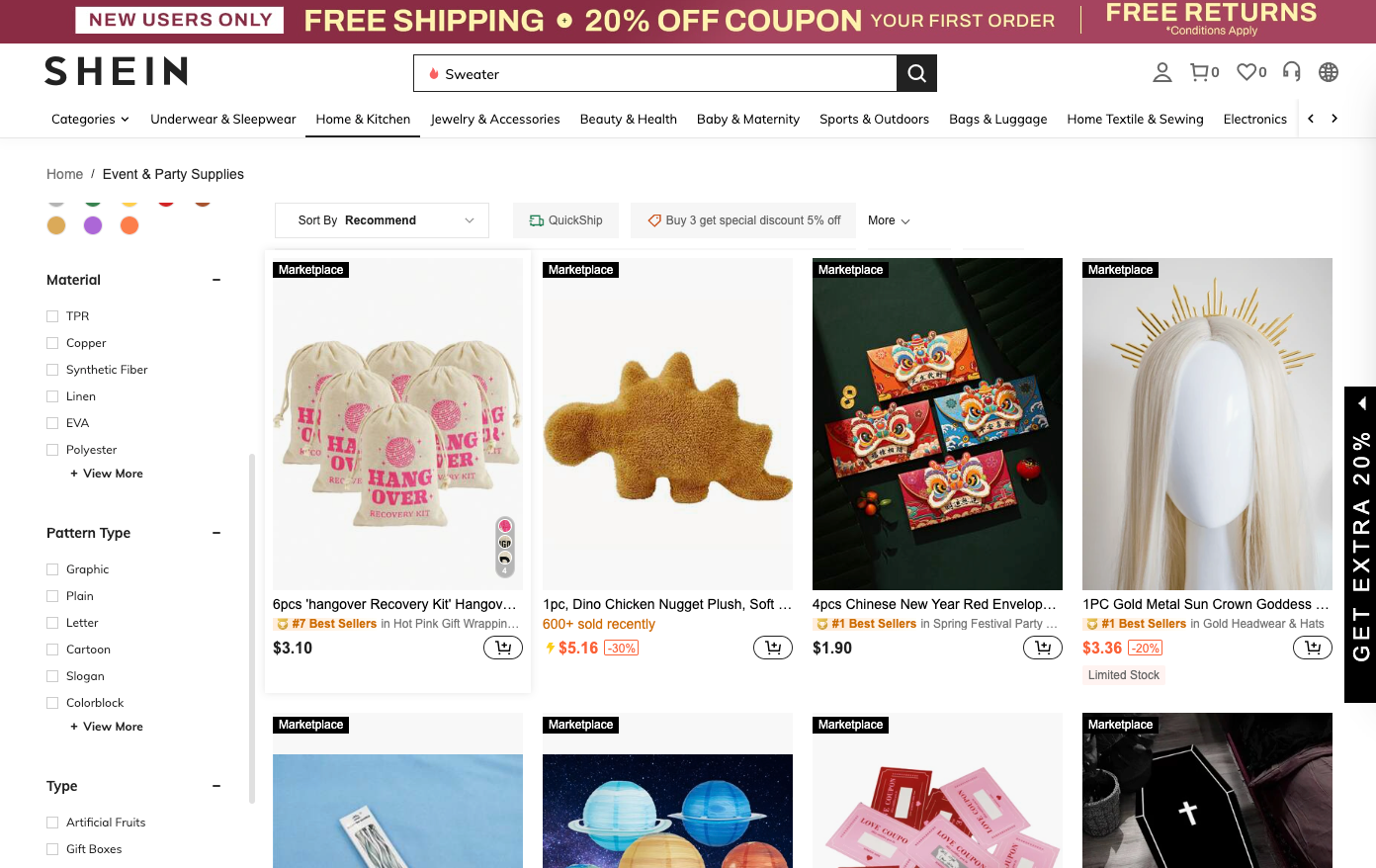
Decor bundles have an obvious use case and can support a higher perceived value than a single item. Demand is time-sensitive, though. A delivery that misses a birthday or wedding has little recovery value, even when the customer eventually receives it.
Use conservative delivery cutoffs, avoid personalized dates, and test packaging for crushed or bent components. Reject the listing if you can't leave a meaningful buffer between the promised arrival and the event.
Give the buyer a last safe order date. Base it on your slowest tracked sample. Add several days for the buyer's own setup. Pull the listing once that date passes.
6. Storage and organizational products
Small storage products are among the cleaner Shein tests because their value is demonstrable and fit can be specified with measurements.
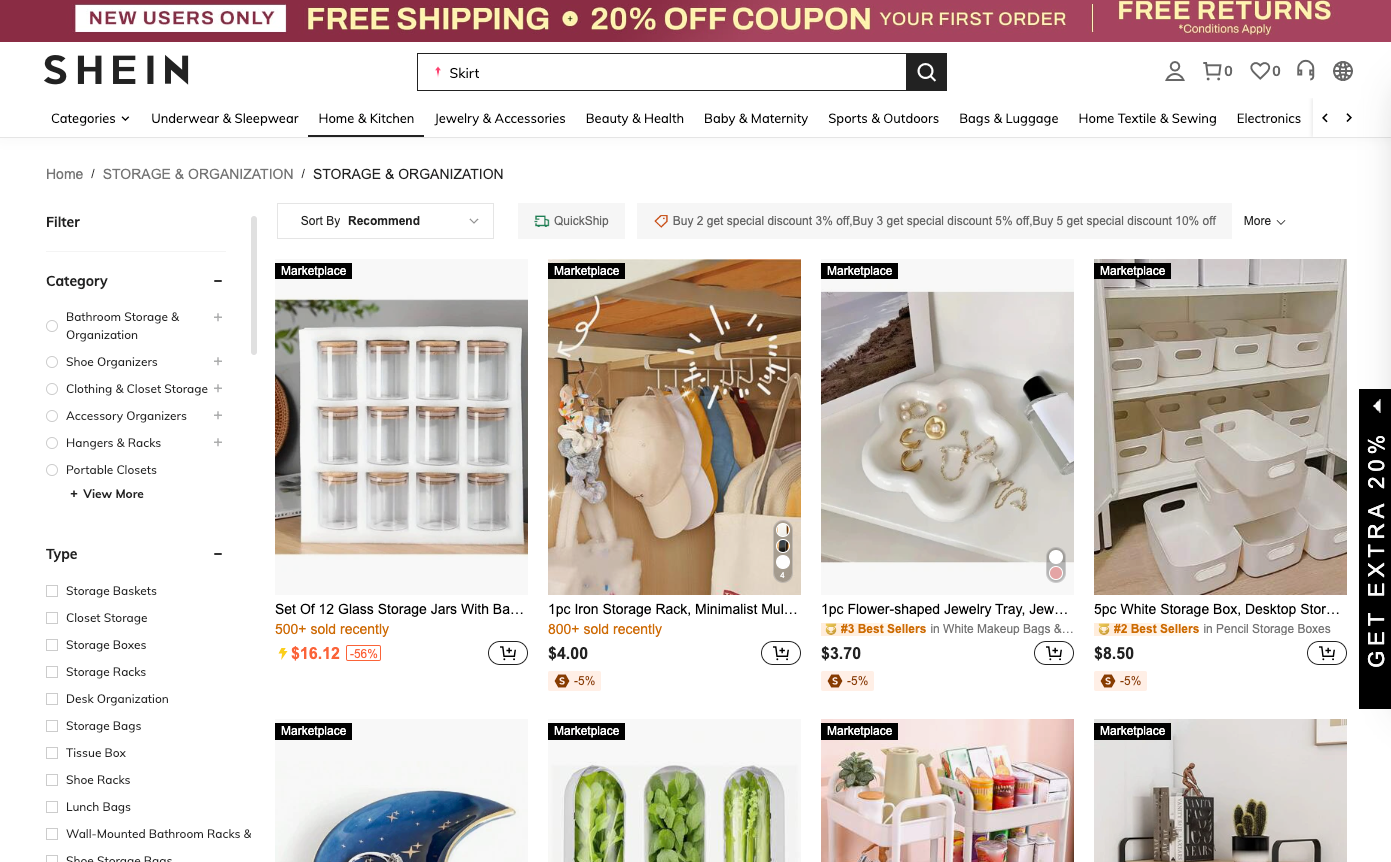
Drawer dividers, cable storage, and compact organizers can be shown in clear before-and-after creative. Exact dimensions matter more than subjective fit, and the current catalog provides enough variants to compare. Bulky organizers lose the advantage because shipping and dimensional damage rise.
Choose a compact item with measurable capacity and no brittle moving parts. Photograph it inside the real drawer, shelf, or bag it claims to organize.
Put the dimensions in both text and one photo. Show the item beside a common object for scale. Fill it with the goods shown in the ad. A buyer should see the true fit before checkout.
7. Water bottles
A plain cold-water bottle is a conditional candidate only when its material records and repeated leak and wash tests support the exact SKU.
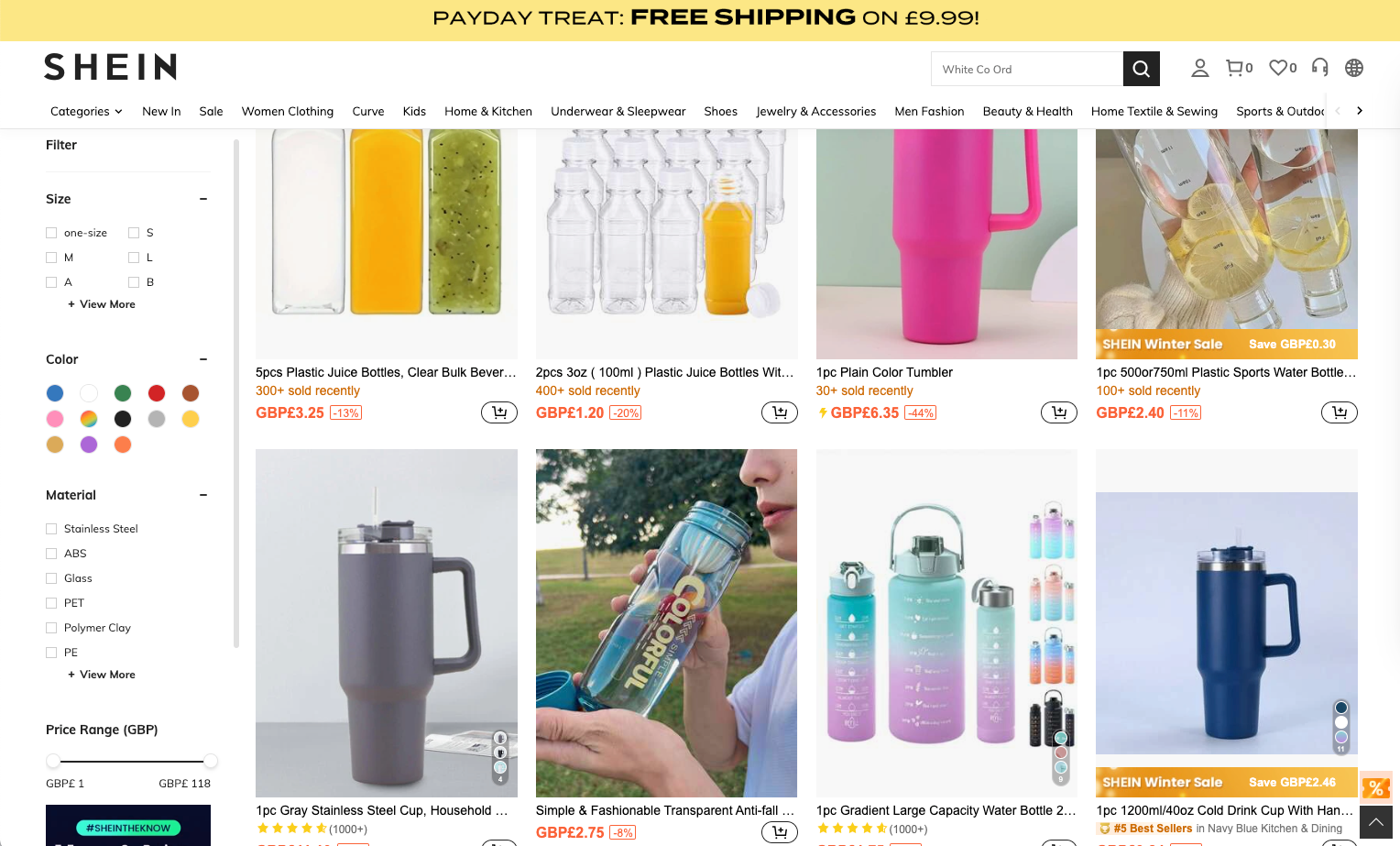
The category is visually marketable, but direct food contact raises the evidence bar. Lids, seals, coatings, straws, temperature claims, and cleaning instructions all affect real use. A leak also damages the customer's other property.
Don't rely on a marketplace description alone. Keep only a plain bottle whose documentation matches the exact material and intended use, then verify the seal and finish on your samples. Rank it below storage products because the evidence burden is higher.
Fill the sample and lay it on its side overnight. Check the seal again after ten wash cycles, and smell and inspect the inner wall. Keep a written record for the exact batch and SKU.
8. Kids' toys
A simple non-powered toy is only a conditional candidate when the exact SKU comes with a complete, matching product file and the sample matches it.
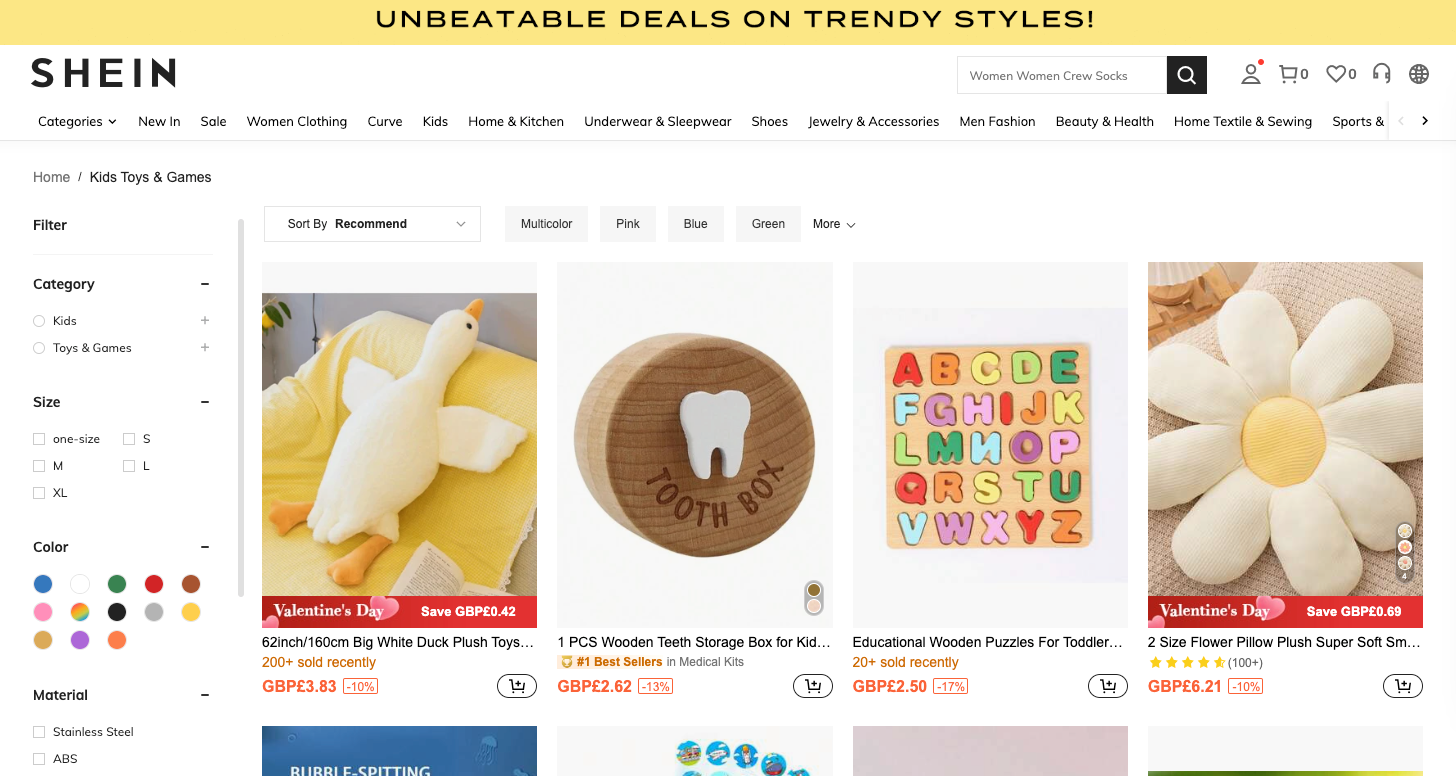
Low price and gift appeal don't offset the documentation burden. Children's goods carry a higher evidence burden than the adult-use products in this list. A retail listing isn't a product file.
Keep a toy on the shortlist only when a qualified reviewer can match its supporting records, maker details, and sample labels to the exact SKU. Simpler adult-use goods remain a cleaner first-store test.
A generic lab report doesn't clear a toy. Match the model number, maker, age grade, and date, and check that each label appears on the sample. If one field differs, treat the file as a mismatch.
9. Men's fashion
Men's fashion offers repeatable basics, but sizing, textile duties, and inconsistent replenishment create the same core risks as women's apparel.
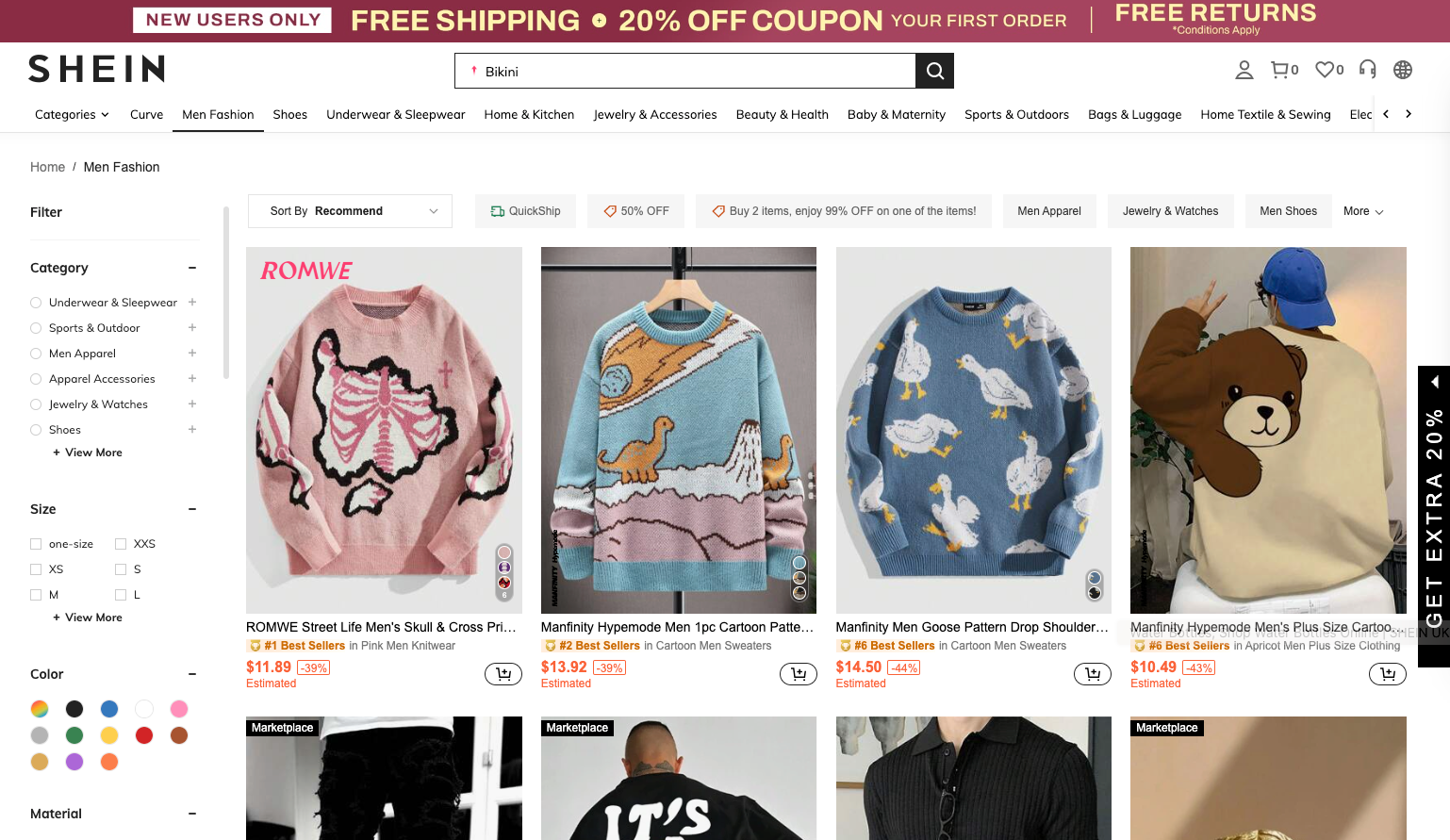
Basic shirts and relaxed garments can be easier to show. Their fit may also be more forgiving than tailored items. Fiber and build still change the tariff code and cost. Each size also adds a stock risk you can't control.
Test one forgiving silhouette, order more than one size, and build your own measurement chart. Reject products whose profitability depends on a low duty assumption copied from a different garment.
Measure the chest, length, sleeve, and shoulder on each sample. Compare them with the live page. Note any gap in inches. A large gap means the listing needs new data or a new SKU.
10. Household cleaning products
Simple manual cleaning tools may be testable, but chemical, powered, or performance-critical products aren't suitable without stronger documentation.
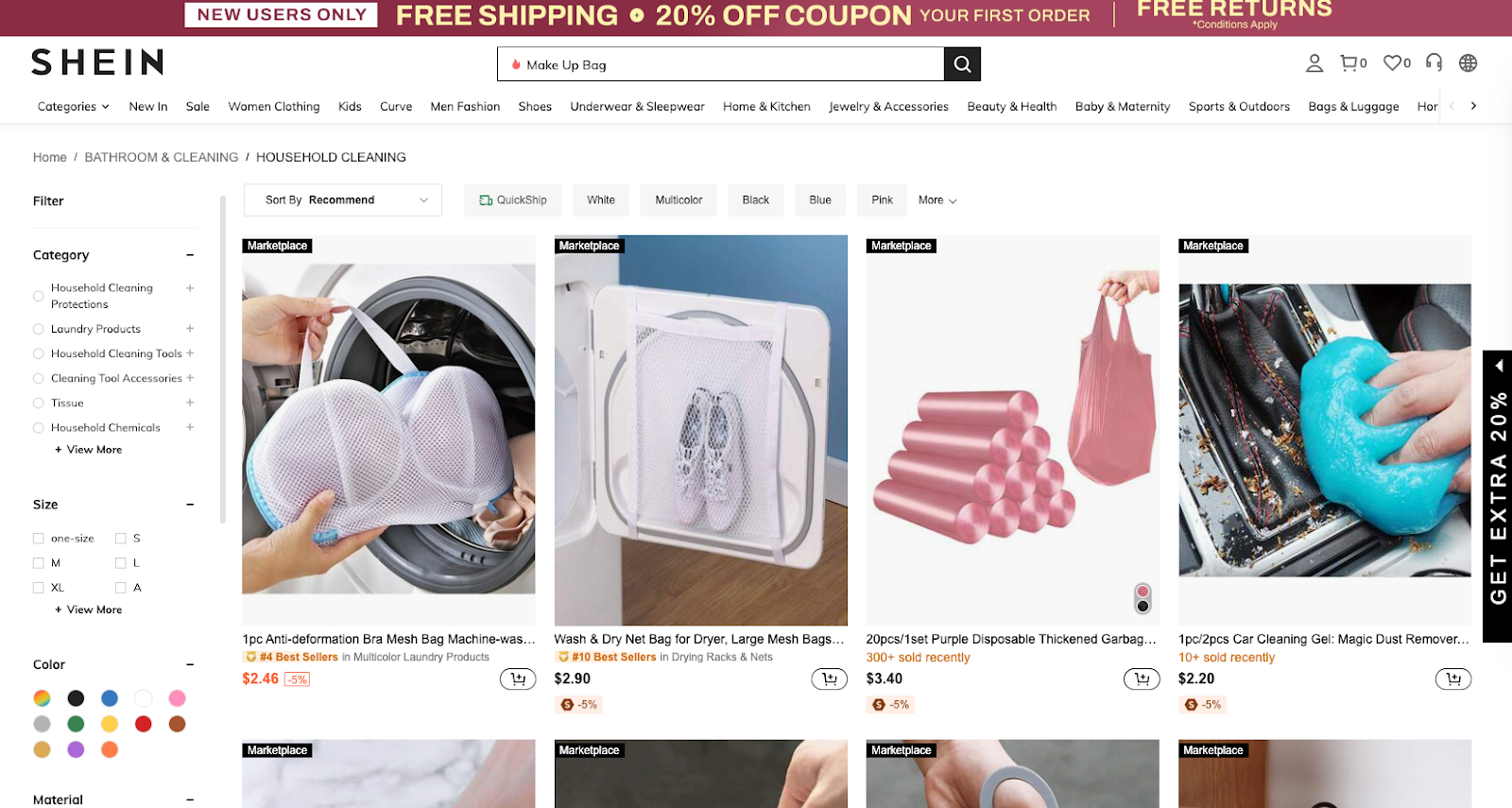
Brushes, lint tools, and compact organizers can demonstrate a clear problem and avoid apparel sizing. Chemical cleaners, plug-in devices, and unsupported germ-removal claims create more serious shipping, safety, and advertising issues.
Stick to non-powered tools with an observable use, inspect edges and durability, and write narrow claims that your sample supports. Reject any item that needs a safety data sheet or technical proof you don't have.
Run the tool through its normal task twenty times. Look for cracks, loose grips, and sharp edges. Film the real result in one take. Keep claims to what that test can show.
Product-fit summary: Sample storage goods, simple party decor, and passive adult accessories first. Treat bottles and simple non-powered toys as conditional candidates only after the exact product evidence passes review.
How to start dropshipping from Shein
Start by validating one SKU, then confirm its landed cost and fulfillment experience before you build a listing or buy traffic.
The sequence is,
- Research the product.
- Source the product from Shein.
- Create your store and add the product.
- Market the product.
- Analyze and optimize.
Each step has a decision gate, so a weak product stops before it consumes the next round of time or money.
1. Research the product
Research one product against demand, competition, compliance, and unit economics instead of choosing from Shein's bestseller label alone. Use live sales counts, review dates, competitor ads, search interest, and product-library trends as separate signals. Then identify the exact HTS classification, origin, delivery method, restricted-product issues, and return exposure. A product passes only when evidence of demand and a workable margin exist at the same time.
Put those facts in one SKU sheet. Add the evidence URL beside each fact. Set a pass price before you browse ads. This keeps a cheap catalog price from steering the whole choice.
2. Source the product from Shein
Order the exact SKU to yourself before selling it so you can inspect the item, parcel, tracking, delivery time, and customer-facing paperwork. Record the product ID, variant, listed origin, and checkout price. Then save the shipping method and promised window. Add the real delivery date, carrier, parcel branding, and fees.
Photograph size and materials with your own camera. Ask the carrier who acts as importer and how charges reach the buyer.
Place two sample orders at different times. One order can hide a stock or route change. Save both tracking paths and carrier bills. A cost that appears only once still belongs in the risk range.
A major SKU change fails the source step. So does a fee that surprises the buyer. The sample must also support each planned claim.
3. Create your store and add the product
Build the listing from your sample and economics, with original media, accurate measurements, a conservative delivery promise, and a clear return policy. An importer can save typing, but it can't verify claims. Rewrite the title and description around the buyer's use, add your sample photos, disclose meaningful materials and dimensions, and set a price from the landed-cost model. Match the return promise to what your business can deliver, not merely to the supplier's policy.
Place a test order through the store. Check tax, payment, confirmation emails, tracking, mobile layout, and the support path before launch.
Open the listing on a phone and finish a real checkout. Read each email as a new buyer would. Follow the tracking link. Fix any date or policy that conflicts with the Shein order.
4. Market the product
Market the tested use case with original creative and a budget capped by the contribution margin available before acquisition.
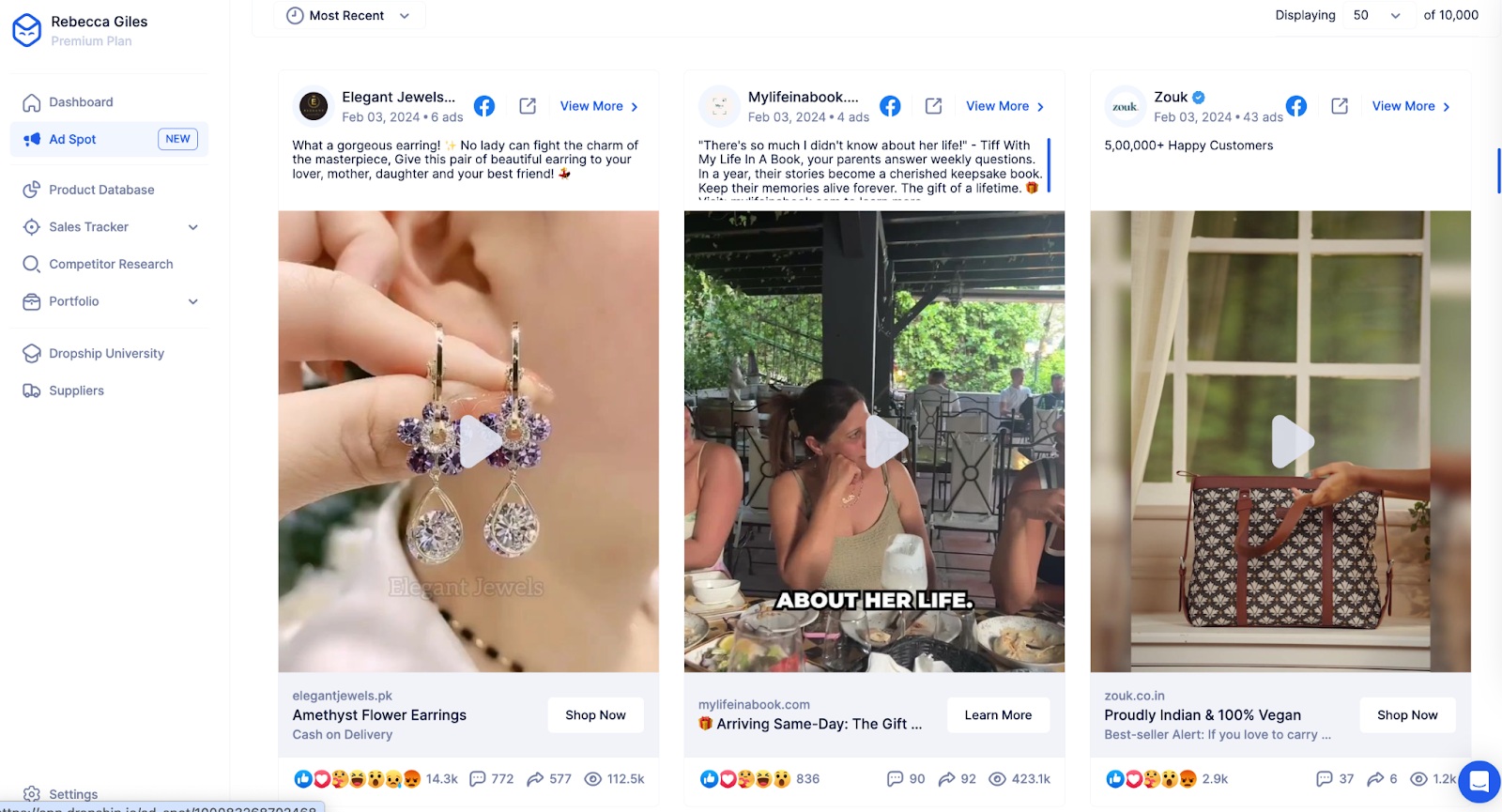
The dress example leaves little room for paid acquisition before store overhead. Improve the offer, raise the tested price, lower a verified cost, or choose another SKU before spending. Don't hide delivery timing or imply an outcome your sample hasn't shown.
Start with a small creative test for one buyer and one promise. Judge it after delivery. The order must stay profitable after refunds and support. An ad-platform purchase alone doesn't pass the test.
Write the stop rule before launch. Pause spend when the cost per sale reaches the pre-ad margin. Review the order again after delivery. A checkout sale can still become a loss through a refund.
5. Analyze and optimize
Optimize from delivered-order profit, cancellation causes, return reasons, and supplier reliability rather than revenue or checkout conversion alone. Track the money by SKU and order date. Save the sale price, discount, item cost, shipping, customs, and payment fee. Add ad cost, refunds, reships, support time, and delivery date.
Record stockouts and variant swaps too. They show whether Shein can support repeat sales.
Update the sheet once a week. Group orders by the date they were placed, and this shows whether a cost or delay changed. Retire the SKU after two bad cohorts instead of averaging the problem away.
After a fair test, keep the SKU only if its margin holds. Real demand can outgrow Shein as the source. In that case, move to a supplier with stock data and plain packaging. It should also offer sound records and steady shipping.
When Shein isn't the right supplier
Shein isn't the right supplier when your offer needs neutral packaging, licensed listing assets, predictable stock, documented compliance, or enough margin for paid acquisition.
We'd reject a Shein listing under any of these conditions,
- Customers mustn't see Shein branding or original retail context.
- The product needs test reports, certifications, traceability, or controlled labeling.
- The selling price can't absorb current duties, entry fees, refunds, and acquisition.
- The exact variant must remain available for repeat customers or bundles.
- Fast replacement and consolidated returns are part of the promise.
- Your listing needs media you haven't created or licensed.
Shein's US return policy generally allows eligible returns within 30 days of delivery. Exclusions and conditions apply. That policy doesn't become your store's return path.
A buyer may send the item to you while Shein rejects it. Long timing can leave your store funding the gap.
Map the full return path before launch. Name the address, payer, cutoff, and refund date, and test that path with the sample order. A missing step means your store must fund the gap.
An open customs, safety, or rights issue can make the order unsafe or noncompliant. In that case, stop before publishing. A cost or listing mismatch can make it unprofitable.
When packaging or stock is the only problem, use Shein for samples. Then move the proven idea to a wholesaler.
Shein alternatives worth checking first
Check alternatives before Shein when supplier authorization, automation, stock control, neutral fulfillment, or lower delivered-order cost matters more than catalog breadth.
Match the alternative to the constraint you need to remove,
- AliExpress fits single-unit tests with more seller choice, but not a store that needs one quality standard.
- Temu fits low-cost product discovery, but not a store that needs neutral packaging or stable resale operations.
- Alibaba fits proven demand, larger orders, and custom packaging, but not a tiny test with no inventory budget.
- CJdropshipping fits one sourcing and fulfillment route when its SKU-level quote beats your other delivered costs.
- A domestic wholesaler fits faster delivery and simpler returns when the higher unit cost still leaves enough margin.
Use our Temu vs AliExpress comparison when those are your final two routes.
Automation and return evidence
AutoDS describes a workaround rather than an official Shein integration.
Easync guidance describes another workaround. It doesn't establish an official Shein integration either.
A 2026 return review provides a secondary check on the consumer policy. Score each route on the same five facts. Use delivered cost, ship time, stock view, package control, and return path. Record one piece of evidence beside each field.
AutoDS's return summary describes the same consumer-policy route rather than a separate dropshipper policy. The seller still owns any stronger promise made to the customer.
Use Shein for a narrow test only after the sample, assets, carrier quote, and post-refund margin pass. If one fails, move to a supplier built for resale. The Dropship.io Product Database is the product-research tool used in this guide.
FAQ
Does Shein have a dropshipping program?
Shein doesn't publish a dropshipping program, public API, or native store link. AutoDS describes workarounds, which don't establish a Shein partnership.
What is Shein's return policy for dropshippers?
Shein doesn't publish a separate dropshipper return policy, so eligible purchases follow its consumer return terms. Your store still owes customers the return and refund terms it promises.
Can I use Shein's product photos on my store?
Don't use Shein product photos unless you have permission or a license that covers your commercial use. Order a sample and create original photos and copy instead.
Does Shein ship faster if I use a US warehouse?
A locally fulfilled item may arrive faster, but you need to verify the exact SKU's dispatch location and checkout estimate. Don't advertise US-warehouse delivery from a category label or a previous order.


