

How to Make Money on eBay: A Seller Plan for 2026
Choose an eBay selling model, calculate the exact listing economics, validate demand and fulfillment, and scale only within proven service capacity.
To learn how to make money on eBay, choose a model you can fulfil and list an offer that still works after fees and direct costs. Owned goods, flipping, wholesale stock, and supplier-fulfilled dropshipping each demand a different mix of cash, inventory risk, and delivery control.
I've run one-time-product Shopify stores, and they taught me to check one order's costs and fulfilment evidence before scaling. eBay's rules differ, but the same operating lesson applies. Test the math, listing promise, and delivery route with one documented offer.
Choose the model first, research the item, and reject it when the numbers or proof fail. Seller Hub shows whether your current listing limit can support more volume.
Key takeaways
How can you make money on eBay?
Start with the model that matches your inventory and fulfilment control. Owned goods put little new cash at risk, while flips depend on inspection and sound pricing. Wholesale needs repeatable supply, and dropshipping needs a wholesale supplier. In every case, list only when the money left justifies the work.
An eBay account lets you create listings, but a sale becomes viable only when it covers every direct order cost. Here, contribution means the money left after product, delivery, eBay, returns, and promotion costs. That figure still isn't a promise of demand or repeat sales.
Profit and cash flow need separate checks. A flip or wholesale order needs cash before it sells. A dropship order may require supplier payment before the sale funds are available.
Every route also needs room for a return or refund. Write down when each cost is due as well as its amount.
Set three limits before publishing,
- Minimum dollars left per order.
- Maximum hands-on time per order.
- Latest dispatch date you can support.
Reject the offer when any one fails. Keep one row for each candidate so the decision stays easy to check. Record who controls the item, when each cost is due, and what proves delivery. Rerun the numbers and listing promise whenever an input changes.
Choose an eBay income model before buying stock
Choose the model whose cash needs and delivery duties you can meet before a buyer pays. Ownership, inspection, storage, and supplier control separate the four paths.
Use this map to find the closest starting point,
- Owned goods: Start with items you already hold and can inspect.
- Flipping: Buy underpriced items only after checking condition and sold prices.
- Wholesale inventory: Buy repeatable stock after demand and landed cost pass.
- Supplier dropshipping: List only with a wholesale supplier and proven delivery.
Any of these models can work, but each has its own failure point. Treat the low, medium, and high labels below as relative starting points. Low cash describes the lack of a batch purchase. Order costs still apply.
Condition control asks whether you can inspect the exact unit. Delivery control asks who packs, dispatches, and provides tracking.
When two routes fit, start with the one that needs the least unproven commitment. Move to wholesale or supplier fulfilment only after its demand or delivery evidence exists.
1. Sell owned goods first
Owned goods give a new seller the lowest-inventory route to a first listing. You control the item, so you can inspect and pack it before a buyer orders.
This route fits a casual seller with unused goods in a known condition. You can learn listing, shipping, buyer messages, and returns without involving a supplier.
Completed sales for the same model and condition support your price. The item in front of you lets you verify its condition, parts, dimensions, and photos. Record these details before choosing a price,
- Any defects.
- Included parts.
- Packed size.
- Delivery cost.
Draft from the item in front of you, test each moving part, and photograph flaws in clear light. Pack it once before publishing. That dry run catches missing pieces and surprise parcel costs while you can still change the price.
If the first listing draws little interest, compare it with the closest sold items. Check their condition, total buyer price, photos, and title. A meaningful difference may explain the weak result. Change one input at a time to see what affects the outcome.
Keep the first order as your baseline. Compare the planned parcel cost with the carrier charge, then note packing time and buyer questions. This shows whether another item fits the process.
I'd start here to learn eBay with the least new cash at risk. The tradeoff is finite supply. A closet cleanout can produce useful sales, but it can't support a repeatable catalog once the items are gone.
2. Flip inspected items
Flipping works when you can buy below a defensible resale price and verify the exact item. Your edge comes from sourcing and condition judgment. This route suits sellers who can inspect and store goods while walking away from a weak buy. Compare completed sales for the same brand, model, condition, and included parts. Subtract these costs from the likely sale amount,
- Purchase price.
- Repair and cleaning.
- Packing and delivery.
- eBay charges.
- A returns reserve.
A high active price only tells you what another seller is asking. Mispricing creates the main loss. A missing part may put your item in a cheaper comparison set, while hidden damage can cause a return. Slow stock also ties up cash and space.
Set the most you'll pay before you travel or bid. Start with a supported sold price, then subtract every known cost and your required contribution. That limit keeps the thrill of a find from replacing the math.
Condition decides where the item fits. Test electronics, count parts, and record model details when they matter. If a defect can't be checked, price for the risk or leave the item behind.
For each flip, save its buy price, repair work, cost, and result. That record shows which finds deserve another buy.
I'd reject a flip I couldn't test or price from the closest sold item. The model is a poor fit if you can't inspect, store, or wait for stock to sell.
3. Buy wholesale inventory
Wholesale inventory fits a seller with demand evidence, cash, and storage or fulfilment capacity. Buying units before an order gives you more control over stock, condition, packing, and dispatch. Supplier terms and a landed-cost quote support supply, while sold eBay results support demand. Bring both into one record,
- Exact variant and case size.
- Unit cost and inbound freight.
- Packaging and storage.
- Return risk and sale price.
When possible, order a sample before committing to a case. Check its variant, size, and damage risk. One sample can't prove every unit, but it can expose a bad description or weak packing.
Set the reorder point before launch. Use units sold during the supplier's lead time, then add a buffer from recent sales. This reduces stockout risk. Prevent overselling by matching listed quantity to stock on hand and pausing when you can't confirm the count.
Wholesale is a poor fit while demand is still a guess. A lower unit cost won't move an unsold case or correct the wrong variant, and storage and returns may consume the expected contribution.
Review the first case against real orders. Check sales pace, damage, buyer messages, returns, and packing time. Reorder only when the results still support the product, supplier, and required contribution.
The main drawback is cash tied up in stock. Start with the smallest useful test order, then let sales and service guide reorders. A larger-case discount isn't enough reason to buy.
4. Use wholesale-supplier dropshipping
Wholesale-supplier dropshipping removes advance inventory while leaving you responsible for delivery and buyer satisfaction. You need a verified wholesale supplier, current stock details, dispatch proof, and a return route.
eBay's current dropshipping policy permits fulfilment from a wholesale supplier. Retail or marketplace forwarding after an eBay sale falls outside that model. Your supplier therefore affects both policy fit and delivery control.
Ask the supplier to confirm the exact variant and stock update method. Get the handling time, carrier route, tracking handoff, packaging, and return address. A catalog feed alone doesn't prove the buyer will get the listed offer on time.
Run one test order to an address you control. Compare the item, parcel, tracking, and arrival with the saved answers. Before a real case, decide who handles a lost parcel, damaged unit, address change, and return.
Stock changes need a stop rule. Pause the listing when the supplier can't confirm the variant or dispatch window. A backup helps only after it passes the same product, cost, delivery, and return checks.
Date each supplier answer because stock feeds, handling times, and carrier routes can change. The record shows when to ask again and keeps outdated promises out of the listing.
This route doesn't fit retail arbitrage or suppliers with unclear stock and dispatch. Its biggest drawback is limited control. You still face the buyer after a late parcel, wrong variant, or failed return.
Use these four decision branches as a final model check,
Run the eBay List-or-Reject profit test
Publish only when the money left clears a dollar floor set in advance. Multiply hands-on minutes by your hourly target, then divide by 60. Reject anything below that floor.
eBay uses a category rate and per-order charge. The fee base includes price, shipping collected, applicable tax, and other charges. Most categories list 13.6% up to $7,500, $0.40 on orders over $10, and 250 free monthly listings in eBay's fee guide.
Consider a $40 item with $8 shipping. Run the calculation in this order,
- Add $40 price and $8 shipping for $48 gross.
- Confirm the category and account terms.
- Apply 13.6% to $48 for $6.53, then add $0.40.
- Subtract $18 product and $7 delivery costs.
- Set aside a hypothetical $3 for returns.
- Subtract optional costs, with zero promotion here.
The example leaves $13.07 before overhead and income tax. A $10 floor passes. A $15 floor rejects it.
Replace the $3 reserve with your return rate × average loss per return. Sales tax is omitted, though it may enter the fee base. Use your own details. Our eBay dropshipping guide applies the full calculation to supplier fulfilment.
Research demand before you source
Completed sales and a sourceable offer beat an active listing or broad trend. Match the condition, price, supply, and delivery.
An eBay category page can name a niche. It doesn't prove demand for one offer.
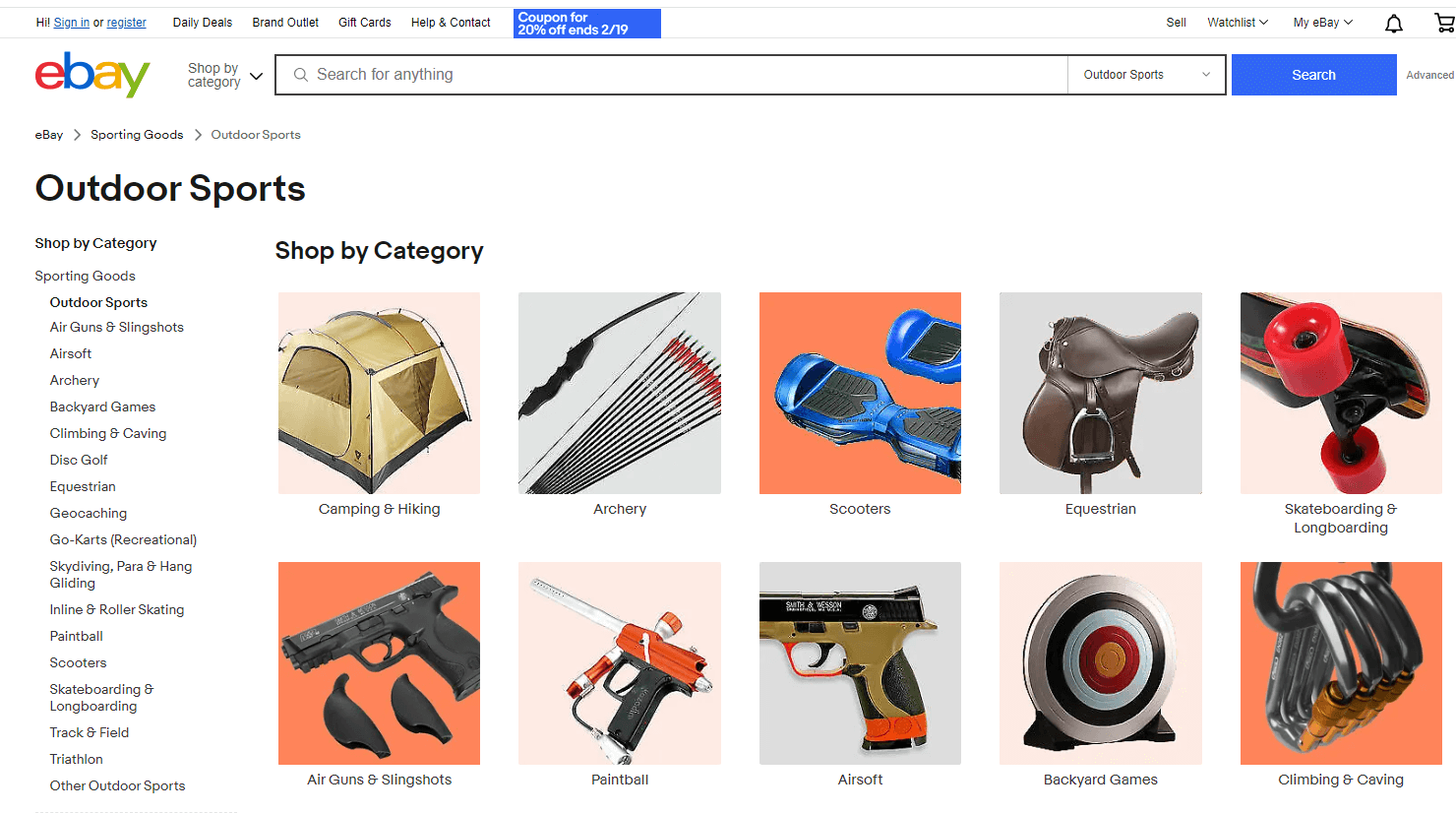
Search by product name, then match model, size, condition, parts, location, and shipping terms. These details decide which results count.
On desktop, open eBay Advanced Search. Enter the item keywords, choose Completed listings, and select Search, and narrow by condition and location. Save the date, terms, and three close matches when available.
Build one evidence record before paying a supplier,
- Recent completed prices for close matches.
- Model, variant, condition, parts, and bundle size.
- Item price plus buyer-paid shipping.
- Source availability, unit cost, and order minimum.
- Packed delivery cost or a supplier quote.
- Return risk and handling route.
- A list, revise, or reject decision from the money left.
Completed sales show past behavior. They don't promise a sale. Record why each match counts and save the range. Reject the offer when delivery or return costs erase the money you need left.
Product Library can screen price, sales, and revenue signals before you confirm the eBay-specific case with close completed listings.
Build a listing that matches the offer
Your listing must describe the exact item you can send. Fields help buyers find it. The condition and fulfilment details set the promise you must keep.
Start with your record. Choose the category and fill item specifics from the item or supplier proof. Put terms near the title's front, but leave out unproven claims.
Match every field to one source. Use your inspection and photos for owned goods. Supplier goods need the variant record and written fulfilment details, and pause if those sources disagree.
Use this pre-publish check,
- Name the brand, model, item type, and variant without stuffing.
- Choose the category that matches the product.
- Select the condition and describe wear, damage, or missing parts.
- Show the real item or verified variant from useful angles.
- List each included accessory and call out anything missing.
- Enter a handling time and service backed by current evidence.
- State the return route you can operate and fund.
For a used item, photograph the stated wear and included parts. With supplier fulfilment, confirm the image, variant, stock, packaging, and delivery estimate match.
Next, read the page from the buyer's view. It should explain what arrives and its condition, total price, delivery date, and return route. Move any answer kept only in your notes into the listing.
Generic supplier photos weaken that promise when they hide a different variant or condition. Extra keywords and a lower price can't fix the wrong delivery. See each field in our listing-to-offer matching guide.
Protect delivery and account capacity
Add listings only when your limits, stock, and delivery process can support them. Active and sold listings count toward monthly limits. eBay reviews accounts every month using sales and buyer feedback.
Check Monthly limits in Seller Hub before planning volume. eBay can set category limits, and its selling-limits guidance says over-limit listings may end. You can relist after renewal or an approved increase.
A weak listing can displace an offer. Update stock when an item sells elsewhere.
Use this capacity decision,
- Read your amount and value limits in Seller Hub.
- Give space to listings with the strongest demand and cost record.
- Confirm owned stock or supplier availability before each sale window.
- Compare tracking, arrival, returns, and buyer messages with the listing promise.
- Request more space after on-time tracking, arrival, return handling, and buyer-message response support it.
- Stop adding listings when stock, dispatch, or support slips.
Guidance can't show your limit or approval date. More capacity depends on your account, category, sales, feedback, and details.
When service slips, reduce active offers before adding tools or promotion. Clear late orders and messages, and fix the stock or supplier record, then run another controlled order.
I'd publish the strongest offer first and compare its real order with the saved cost and delivery record. That order tests the operating process. Check Seller Hub separately before asking for more listing space. Once those checks hold, use our tactics to increase eBay sales without outrunning fulfilment.
FAQ
Is dropshipping permitted on eBay?
eBay permits dropshipping from a wholesale supplier while holding you responsible for delivery and buyer satisfaction. Buying from another retailer or marketplace after the sale is prohibited, so keep dated supplier records and pause when stock, handling, tracking, packaging, or returns can't be confirmed.
Can you start selling on eBay for free?
You can open an account and may get a zero-insertion-fee allowance, but sales still create costs. Check your current allowance and fee category because product, delivery, returns, final value fees, and promotion can still cost money.
Should you price from active or sold listings?
Use sold listings as the stronger price baseline because they show completed transactions. After setting that range, use active listings to compare current offers by condition, shipping, and delivery.
What happens when you reach an eBay limit?
eBay may end listings above your current limit, which may return after renewal or an approved increase. Check Monthly limits in Seller Hub and leave room when stock records or support capacity can't justify another offer.


