

ShopHunter vs Dropship.io: Which Tool Is Best for You?
Compares ShopHunter’s Shopify revenue estimates with Dropship.io’s TikTok Shop, ad, and competitor research so readers can choose the platform coverage they need.
Shophunter vs dropship.io comes down to which platform's features, data coverage, and workflow match the job you need done. This 2026 review compares 2 named options across usability, integrations, support, and non-price limits to build the shortlist below.
Key takeaways
ShopHunter vs Dropship.io: which is best for me?
Dropship.io fits broader product research across several channels, while ShopHunter fits a focused Shopify revenue-estimation job. Choose Dropship.io when you need TikTok Shop sales or Facebook ad activity. Choose ShopHunter when you want to stay inside Shopify competitor research.
What is Dropship.io and who is it best for?
Dropship.io is a product-research platform for sellers who want several types of market data in one subscription. Its tools cover TikTok Shop products and sellers alongside Facebook ads and Shopify competitor discovery.
TikTok Shop data shows marketplace sales. The Ad Library shows Facebook promotion, while Competitor Research finds stores carrying a product. This broader scope helps when one modeled Shopify revenue figure can't settle the decision.
The drawback is breadth. A short Shopify watchlist may not need the extra libraries or research paths.
The strongest fit is a seller who checks more than one channel before testing a product. You can inspect TikTok Shop sales first, then look for related Facebook ads or sellers carrying the item. That wider path takes more clicks, but each screen answers a separate question. It also stops one attractive estimate from making the whole decision.
What is ShopHunter and who is it best for?
ShopHunter is a Shopify product and competitor-research tool built around estimated store revenue, product discovery, and ad activity. Its public site says it uses traffic patterns, ad counts, and conversion behavior to estimate daily revenue.
ShopHunter suits a seller who wants one Shopify-centered view and accepts that the output is modeled. The public interface groups store revenue, ads, product results, pricing changes, and historical trends. The guide to the best Shopify spy tools explains where that storefront focus fits among other research products.
The tradeoff is evidence because ShopHunter names some inputs but publishes no validation study. The site also omits a price list, so you must reach the app before seeing the full terms.
Its best fit is repeated Shopify watchlist work. Saved stores, hourly updates, and historical charts can shorten that routine. The poor fit is any decision that needs confirmed revenue, TikTok Shop data, or public plan terms. In those cases, ShopHunter leaves a second tool or manual check in the process.
ShopHunter vs Dropship.io: feature comparison
Dropship.io spreads research across commerce and advertising channels, while ShopHunter concentrates its features on Shopify-store estimates. Pick the tool whose data answers the question holding up your next product test.
Dropship.io features
Dropship.io separates product, shop, creator, ad, and competitor research into dedicated tools. Its live product pages describe these core jobs:
- Sales Tracker: Monitors a TikTok Shop product or seller over a fixed date range.
- Product Library: Filters TikTok Shop products by sales, price, revenue, or category.
- Shop Library: Compares TikTok Shops, their products, and sales history.
- Ad tools: Finds active Facebook promotion, ad spend, and creative activity.
- Creator Library: Finds TikTok creators by promoted products, videos, and sales.
- Competitor Research: Finds stores carrying a product through search or images.
- Magic AI Search: Finds possible product and ad matches from text or an image.
Sales Tracker measures TikTok Shop activity. Competitor Research finds product listings and seller sites. Keep those data sources separate when comparing demand.
Use Product and Shop Library when an exact item shows recent sales at a workable price. Check the listing, seven-day sales, and landed cost. Creator Library can guide outreach, but results may not transfer to another product. Magic AI Search and Chrome Extension speed up discovery, but each match needs a live-listing check.
Portfolio supplies weekly ideas, while Chrome Extension adds browser research. Treat both as lead sources. Before testing, confirm the product, seven-day sales, margin, and supplier delivery time.
ShopHunter features
ShopHunter keeps its public feature set centered on Shopify competitor analysis, product discovery, and recurring estimate updates. Its homepage groups the work like this:
- Competitor Analysis: Ranks Shopify stores and products by modeled results, which you can test against a store you control.
- Product Discovery: Filters products by sales velocity, store size, price, or age, then leaves you to inspect the live listing.
- Real-Time Data: Updates tracked products hourly and lets you check a sharp change against store records or another source.
That narrower design can be faster when you only want to rank Shopify stores or products. ShopHunter says it monitors changes and alerts users to new trends. The material drawback is false precision. A detailed revenue figure can look firmer than the public method supports.
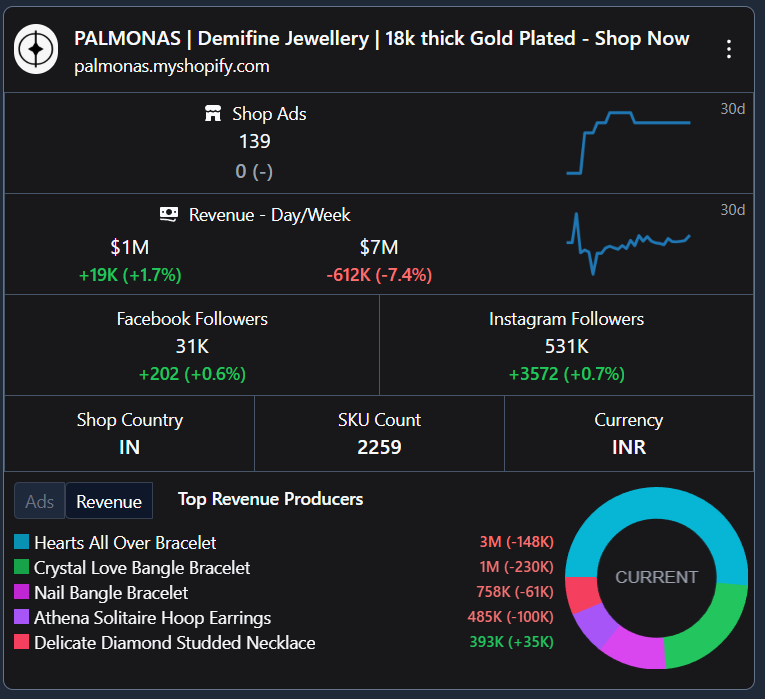
The interface is built for comparison at a glance. A store card can show ads, estimated revenue, followers, location, product counts, and top items. That density helps you sort a watchlist, while the model weights and likely error range remain unclear.
ShopHunter vs Dropship.io: similarities and differences
Both tools speed up product and competitor shortlisting, but they use different platforms and data. Their shared research jobs explain the comparison. Their data sources determine the better fit.
ShopHunter and Dropship.io similarities
ShopHunter and Dropship.io both turn public commerce data into a faster product-research shortlist. The shared jobs include:
- Finding products that appear to have sales or advertising momentum.
- Searching and filtering products before paying for a test.
- Monitoring competitors and changes over time.
- Showing product, price, store, and advertising details.
Every third-party research tool depends on data the platform exposes. In 2023, store owners reported that a Shopify change disrupted several trackers. When an estimate jumps, check the same store and date range in another tracker before changing a product decision.
ShopHunter and Dropship.io differences
ShopHunter models Shopify-store revenue, while Dropship.io combines TikTok Shop sales research, Facebook ad research, and Shopify competitor discovery. The main differences are easier to scan side by side:
ShopHunter is the closer fit when Shopify estimates are the whole job. Dropship.io makes more sense when your research also needs marketplace sales, creator activity, or Facebook ad evidence.
Use a modeled Shopify figure to rank stores for a closer look. TikTok Shop sales can check marketplace demand, while Facebook ads show paid promotion. Before testing, calculate gross margin, confirm supplier delivery times, and review the ad creative you can produce.
ShopHunter vs Dropship.io: Plans, features, and access
The comparison separates vendor prices from reported prices:
Dropship.io plans
Confirm the trial length before starting.
All three plans include the main research tools. The published limits separate them:
Count a normal week's searches and tracked items, then compare that total with the limits above. Start with monthly billing while you measure usage. Switch to yearly billing when the savings justify the longer commitment.
ShopHunter plans
ShopHunter's homepage shows demo and sign-up links but no plan table. Older pages mention Business and Enterprise tiers. The vendor doesn't publish those tiers, so they aren't included here.
The two linked sources use Basic and Pro or Professional as the plan names. The table includes those two tiers because the public evidence agrees on their prices.
Confirm the amount, renewal date, cancellation steps, and included limits on the checkout screen before entering payment details. That action answers the part no public comparison can settle.
Is ShopHunter's data accurate?
ShopHunter's public evidence leaves accuracy unproven, so its revenue estimates work best for ranking leads. Its Trustpilot profile shows 1.6/5 from 50 reviews. Trustpilot also notes that reviews are user opinions and may not represent every customer.
ShopHunter names traffic patterns, ad counts, and conversion behavior as model inputs. That gives buyers some context. It still omits the weights, test sample, and error range. The guide to Shopify sales trackers explains why a precise dollar figure can still be modeled.
Two reviewers supplied concrete comparisons. A representative validation sample is still missing.
Every storefront tracker can miss orders or misread public data. Use the estimate only to rank leads, then verify the strongest one with store records or another tracker before buying stock or ads.
Run a simple accuracy check on a store you control when possible. Compare the same seven-day range with your store records. Divide the absolute sales difference by actual sales to find the percentage error. Record any nonzero estimate for a zero-sales store as a false positive.
Drop the estimate from buying decisions when that error would change which product ranks first. A close result on one store still doesn't prove the model works across every niche.
ShopHunter vs Dropship.io: support and training
Dropship.io has a full public learning library, while ShopHunter has a homepage FAQ, demo, and support contact. Dropship.io publishes quick tutorials, a university, a blog, FAQs, and a community link from its main navigation.
When you're learning to read estimates, training should explain whether product movement supports more research or real spending. Public instructions also let you assess the steps before creating an account.
ShopHunter's site answers basic method and product-check questions, but it offers fewer public lessons than Dropship.io. An experienced seller may give this less weight than channel coverage or estimate quality.
A beginner can test the learning material before choosing a tool. Pick one product and open the Competitor Research lesson from Dropship.io's Quick Tutorials menu. For ShopHunter, request the public demo and ask support to explain the estimate inputs. Choose the platform whose instructions let you reach a product-test decision without guessing what the dashboard means.
Final thoughts: is ShopHunter or Dropship.io better?
Dropship.io is the stronger general research choice, while ShopHunter remains a narrow option for sellers who specifically want modeled Shopify revenue. Dropship.io publishes its prices and covers TikTok Shop, Facebook ad, and Shopify competitor research. ShopHunter's simpler focus can still suit someone who values that one view above broader coverage.
ShopHunter's checkout terms remain unresolved because its public site omits them. Its Trustpilot record also weakens the case for using a revenue estimate as a buying forecast. A precise dollar amount doesn't remove that risk.
Choose Dropship.io when you want TikTok sales and Facebook ads beside Shopify competitor research. Choose ShopHunter when modeled Shopify revenue is the deciding view and you can validate it against a store you control. If neither data set matches the channel you sell on, the best ShopHunter alternatives maps other tools to their sources.
Frequently asked questions
These answers settle the price, beginner fit, trial, accuracy, alternative, and troubleshooting questions left after the comparison.
Is Dropship.io or ShopHunter better for beginners?
Dropship.io is better for beginners who want public tutorials and several data sources, while ShopHunter is simpler for ranking Shopify stores by estimated revenue.
What's the best alternative to ShopHunter?
Dropship.io is a stronger ShopHunter alternative when TikTok Shop sales and Facebook ad research matter beside Shopify competitor discovery. A closer Shopify-only replacement may fit better when modeled storefront revenue is the deciding measure.
Is ShopHunter's sales data accurate?
ShopHunter's estimates may help rank leads, but its public evidence doesn't support treating them as exact revenue. Compare the same seven-day range with store records or another tracker before acting on a result that would change your spending.


