

Competitor Ad Copy Monitoring Strategies (2026 Guide)
Explains how to choose an ad-monitoring tool, set a review cadence, interpret competitor signals, and turn useful patterns into original creative tests.
Competitor ad copy monitoring strategies track the ads your competitors run so you can find useful patterns without copying their work. A set schedule turns their public creative tests into market research for your campaigns.
I've launched plenty of ads while running online stores. Most of the ad spy tools in this guide have been part of that work. My early mistake was checking competitor ads once, saving a few ideas, and calling that research. A repeatable watchlist gives those observations a job.
This guide helps you choose the right tool, read the right signals, and turn one promising ad into an original test.
Key takeaways
What does competitor ad copy monitoring mean?
Competitor ad copy monitoring tracks which ads a rival runs, where they appear, and how long they stay active. You record the offer, opening hook, proof, call to action, creative format, and audience clues. Repeated checks then show what changed and what survived.
The value comes from separating structure from expression. A competitor might open with a question, demonstrate the product, and finish with social proof. Test that sequence with your own claim, footage, and customer evidence while leaving its script and design behind.
I keep an ad only when it gives me a testable reason to change my own work. An isolated ad may have no engagement, history, or sales signal. It could be a failed experiment and deserves less weight than a long-running creative.
Free vs. paid ad spy tools
Free ad libraries suit current creative discovery. Paid spy tools add history, saved monitoring, deeper filters, or several networks in one search. Choose based on the evidence you need after the first search.
A large database doesn't help if it can't track the platform or competitor that matters to you.
Use this eight-tool map:
- TikTok Creative Center: Free TikTok creative and performance clues.
- PowerAdSpy: Paid multi-network search with saved research.
- AdSpy: Deep Facebook and Instagram creative search.
- Dropship.io: Ad research joined with product and sales data.
- Dropispy: Dropshipping ad discovery with shop research.
- BigSpy: Broad platform coverage with a limited free plan.
- Meta Ad Library: Free official search for active Meta ads.
- AdFlex: Cross-platform history, alerts, and e-commerce research.
The sections below use the same baseline of coverage, history, price, dropshipping fit, and the main drawback.
1. TikTok Creative Center
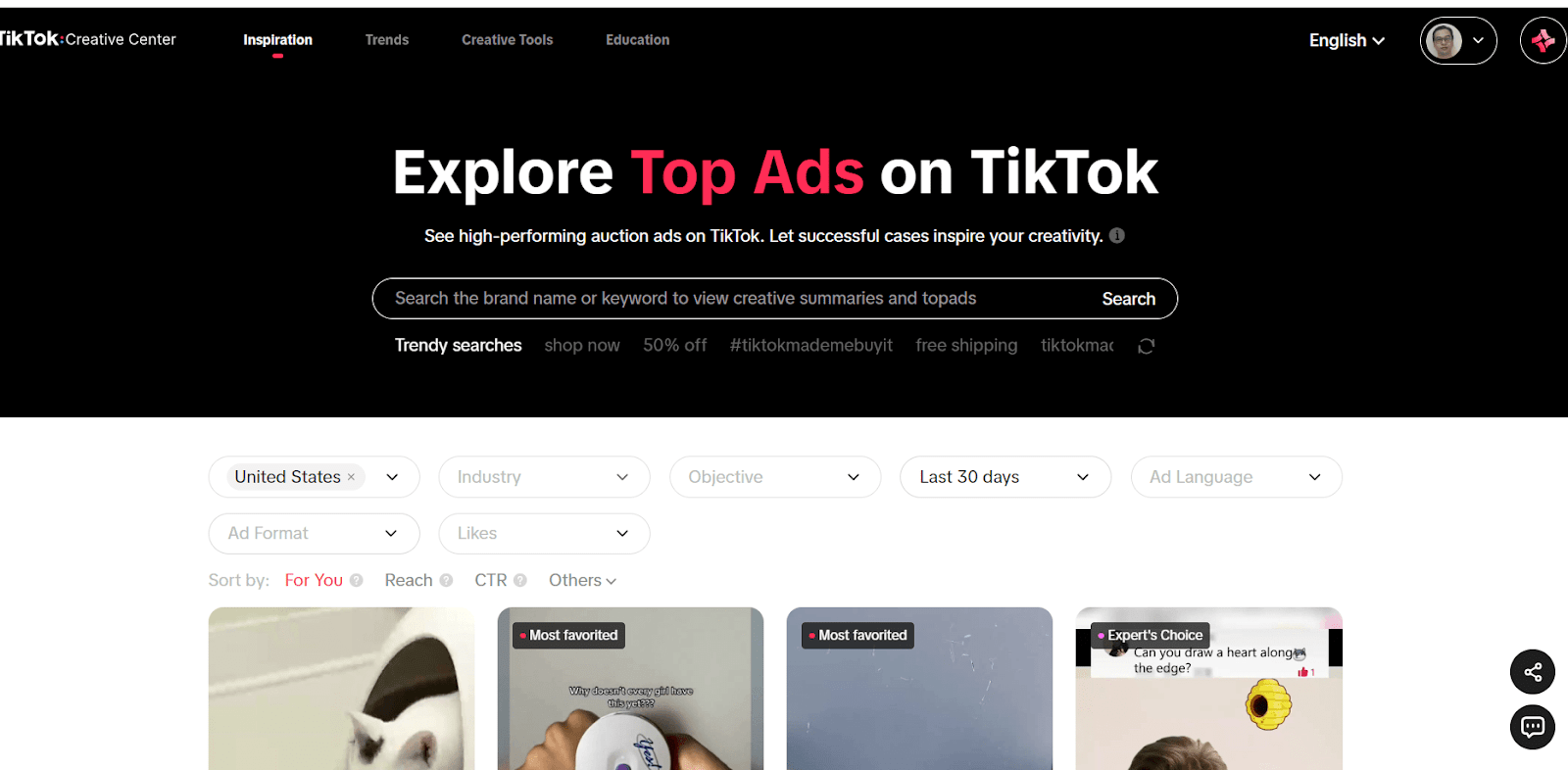
TikTok Creative Center is a free library for TikTok hooks, formats, and high-performing moments. Its coverage is TikTok, and Top Ads can be filtered by region, industry, objective, language, format, likes, and time frame. The time-frame filter offers a recent performance view rather than a full advertiser history.
The free tool is best for sellers who need an opening, demonstration, or call-to-action hypothesis for TikTok. Logged-in users can sort by reach, click-through rate, conversion rate, likes, and short-view rates. They can then inspect where a video's relative performance peaked.
Its main drawback is limited monitoring depth. Top Ads includes advertiser-authorized, high-performing creative rather than every ad a named rival has run. Use it for free TikTok discovery and use Facebook Ad Library competitor research when Meta is the channel.
2. PowerAdSpy
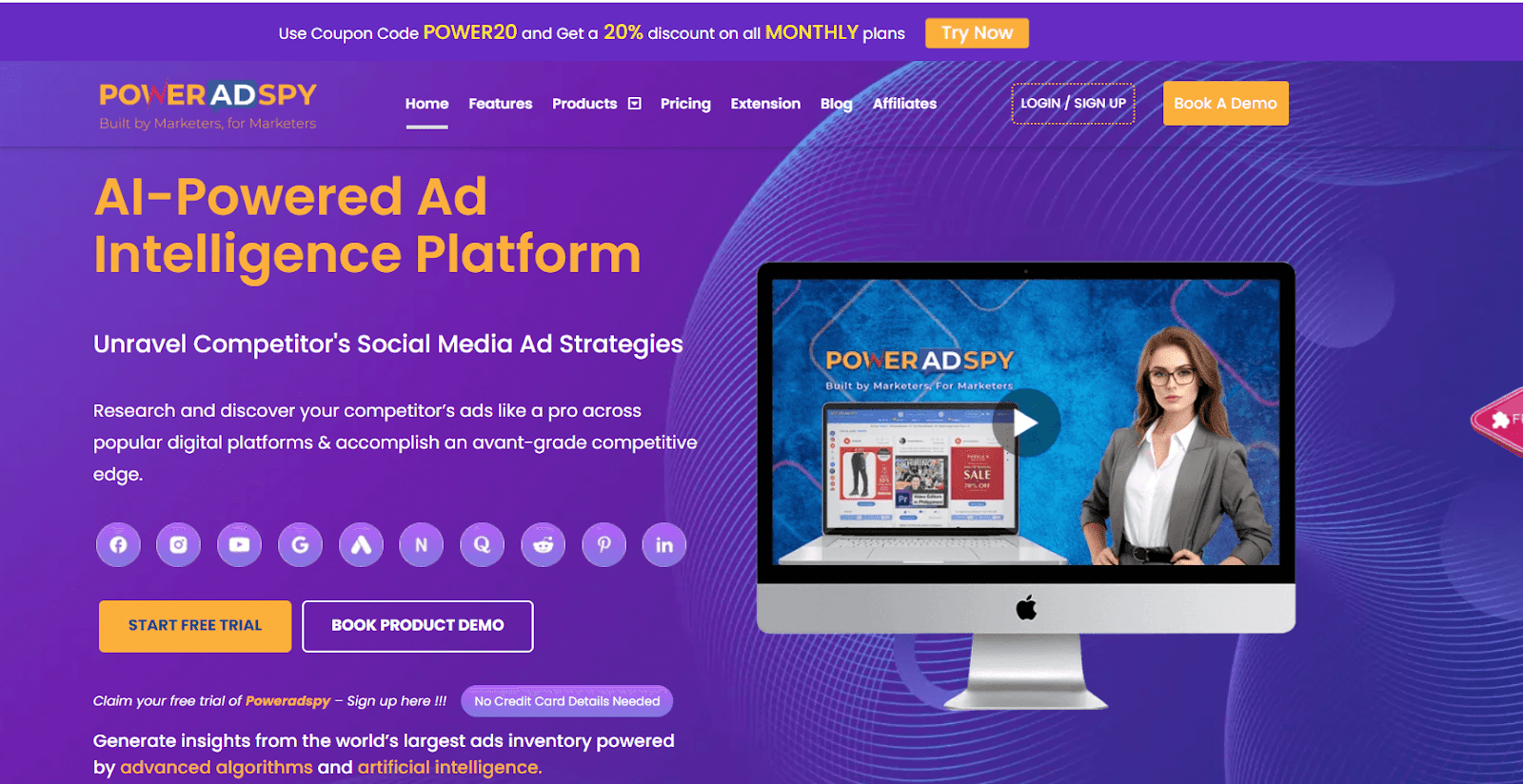
PowerAdSpy covers 11 networks and fits sellers who need saved, cross-network research. Basic covers Facebook and Instagram. Higher plans add Pinterest, Google Display, YouTube, native ads, Google Search, LinkedIn, TikTok, Quora, and Reddit.
Bookmarks and longest-running sorting add the history needed for an ongoing watchlist. The monthly Basic plan costs $69, while broader network coverage costs more. It's a good fit when you know which channels you need before paying.
The plan structure is the main drawback because the entry offer doesn't include every filter or network. Check the listed coverage instead of choosing by trial price. An official library can handle a one-off search.
3. AdSpy
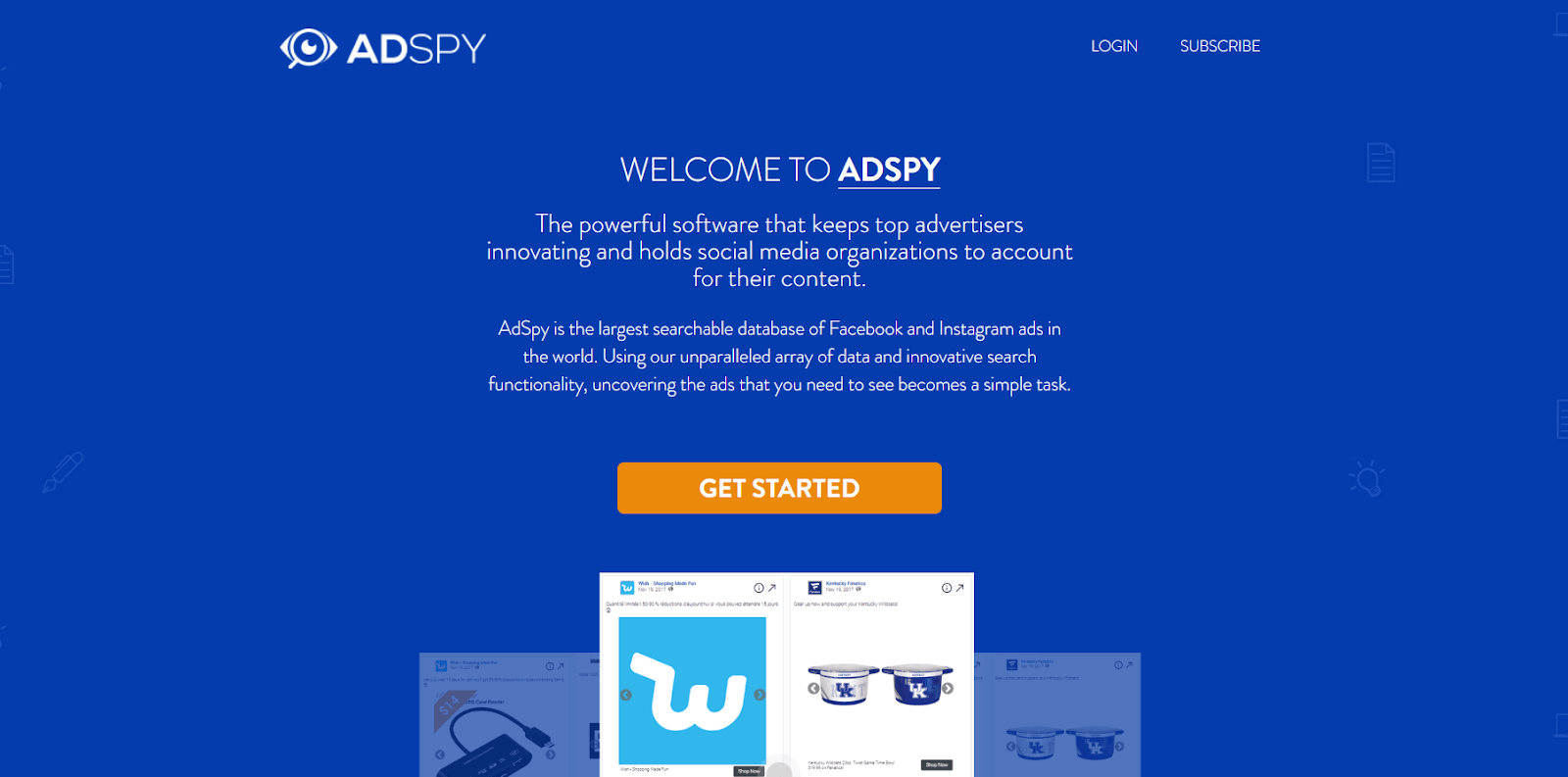
AdSpy covers Facebook and Instagram and is a strong fit when comments or run duration matter. Its filters include ad text, URL, page name, affiliate, landing page, demographics, and comments. Those fields can narrow a broad niche search to one advertiser or a repeated customer objection.
The longest-running filter provides its history signal. AdSpy lists 211.2 million ads across 225 countries and charges $149 per month. It fits a Meta-focused team that searches several markets or languages.
The main drawback is the single high entry price. It makes little sense when you need only a few current examples. The Meta-only focus also makes it a poor fit for a TikTok-first store.
4. Dropship.io
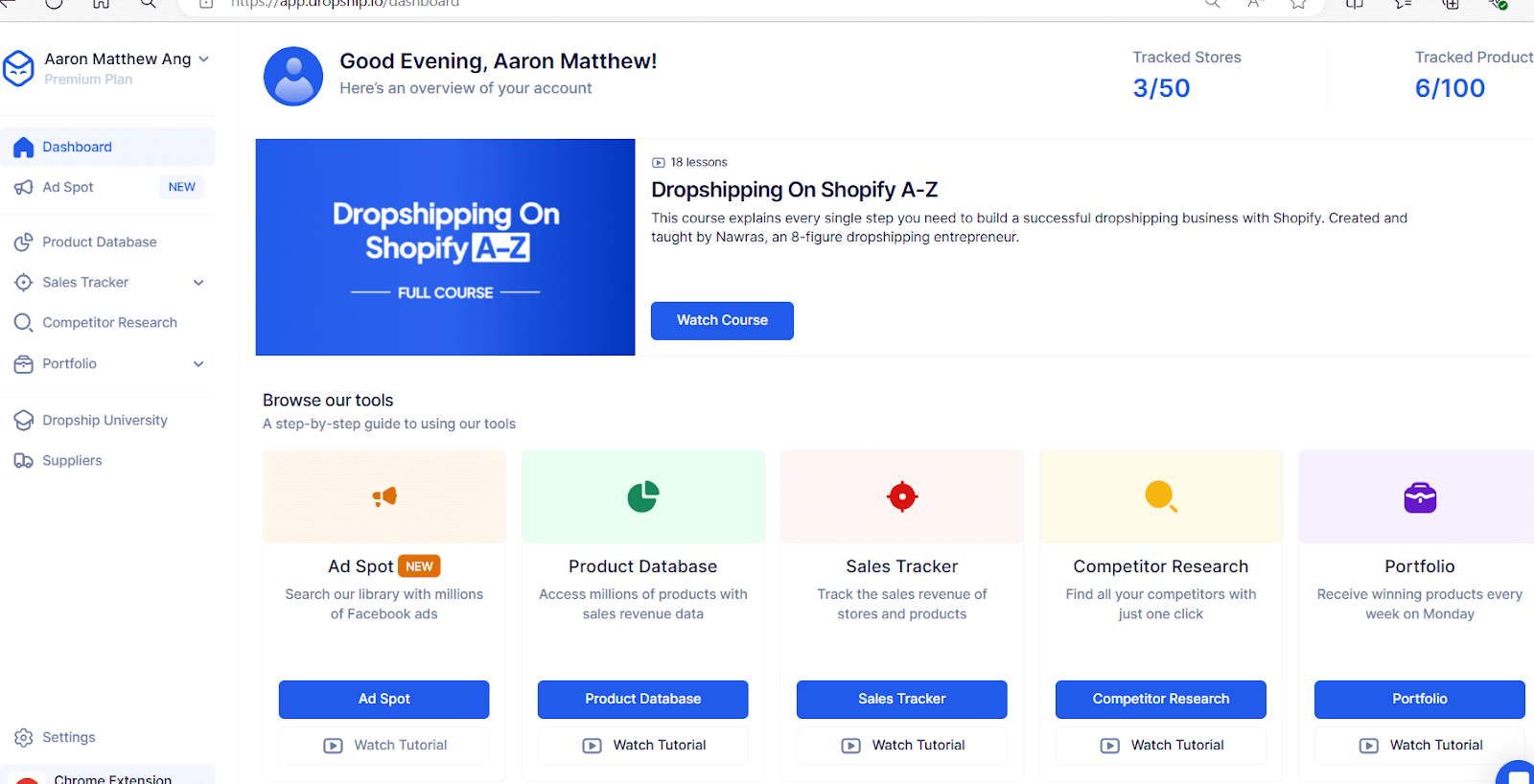
Dropship.io covers Facebook ads and fits sellers who want product, advertiser, and store data beside the creative. Ad Library, Competitor Research, and Sales Tracker connect the ad to store and product context.
Advertiser Tracker watches for new creative, while Sales Tracker adds a time-based demand proxy. I use that combination to reject attractive ads attached to weak products before they enter my idea file.
The Basic plan offers monthly and annual billing. The main drawbacks are plan credits and tracked-database coverage. It's a poor fit for teams outside e-commerce or sellers who need only a free platform library.
5. Dropispy
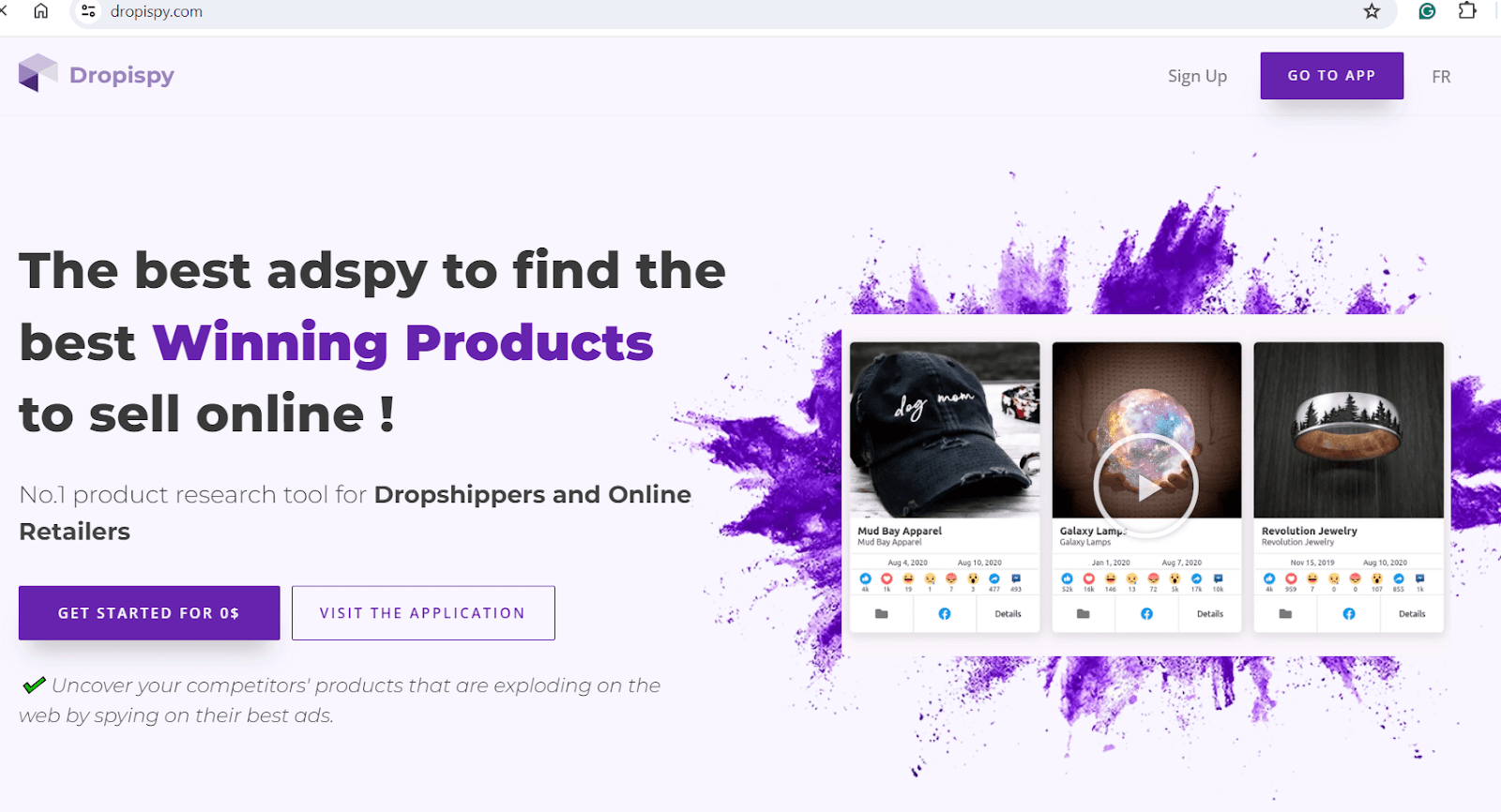
Dropispy covers dropshipping ads and shops, making it a specialist choice for product sellers. Its public page offers a platform-type filter but doesn't name a fixed network list. Adspy searches creative, while Shop Spy adds store-level context.
Recent-ad filters supply the time dimension for monitoring. Dropispy offers a free plan, Premium at $29.90 per month, and Business at $249.90 per month. Premium adds 150,000 monthly credits, advanced filters, and Shop Spy access.
The narrow dropshipping focus is also the main drawback. It gives a general marketing team less value than a broad ad-intelligence platform. Paid credit limits also matter if several people will search all day.
6. BigSpy
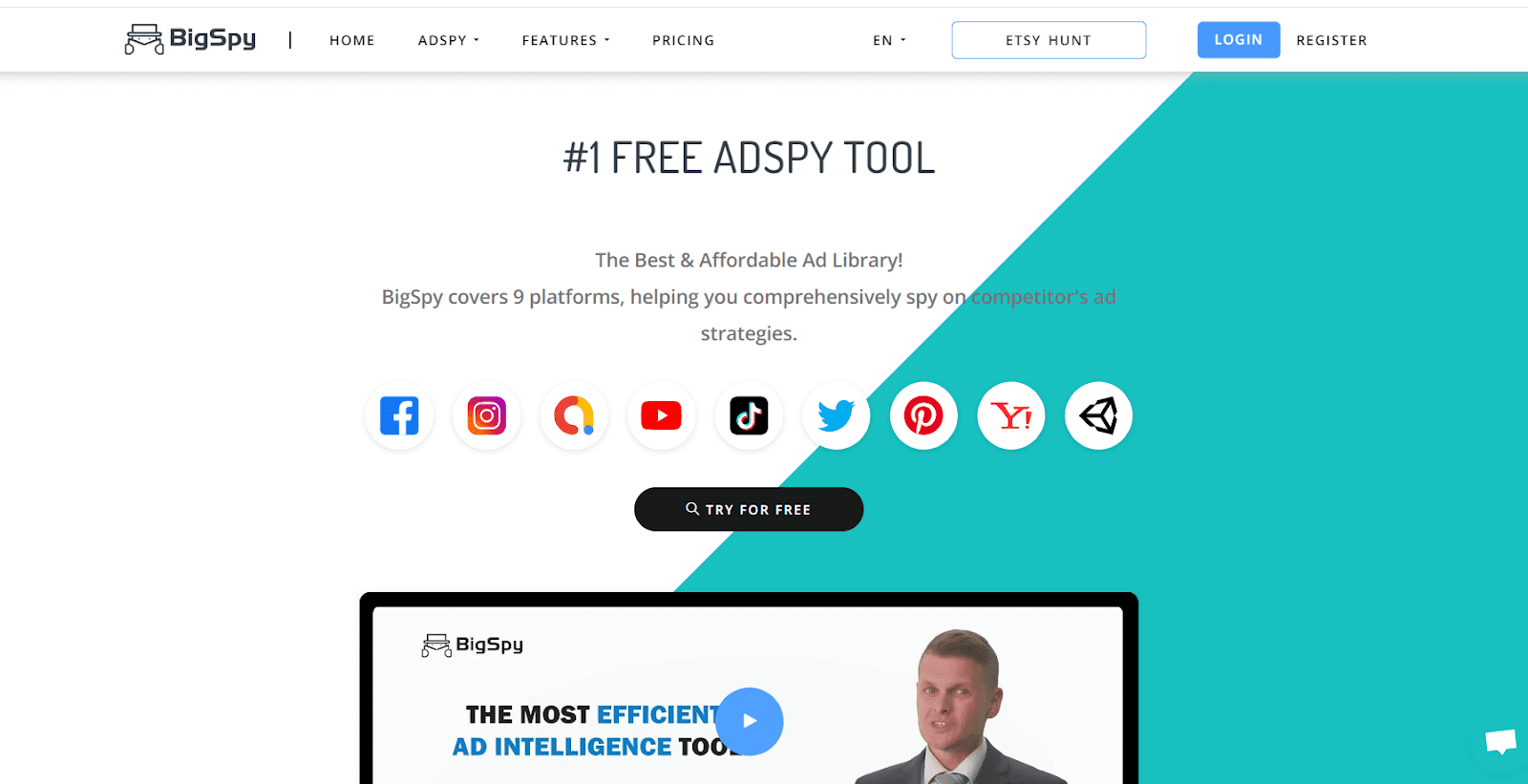
BigSpy covers several social networks and fits sellers who want to test the interface before paying. Its free plan covers Facebook with five searches and 20 creative downloads per day. Paid plans add more platforms, ad copy, creative charts, page analysis, and TikTok analysis.
Creative charts and page analysis provide the monitoring history missing from the free plan. Starter costs $69 per month for Facebook and Instagram. Growth adds TikTok, Google Ads, YouTube, X, and Pangle.
The main drawback is that the free plan omits ad copy and advanced analysis. BigSpy is a poor fit when you need one platform and already have a capable official library. Choose it when cross-network browsing is the reason you're paying.
7. Meta Ad Library
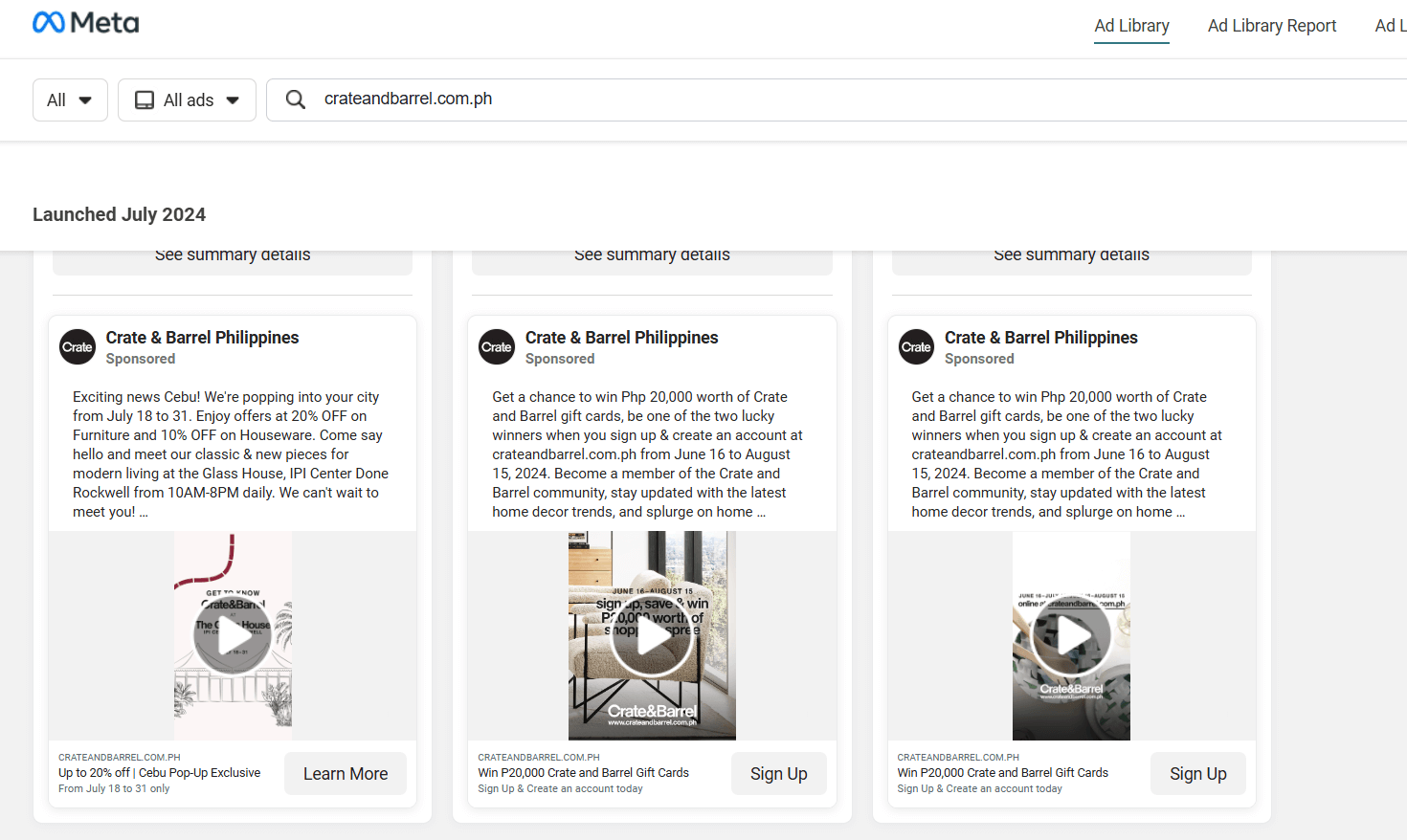
Meta Ad Library is a free official source for active ads across Meta technologies. Search by keyword or advertiser, then filter by location and ad category. It fits sellers who need a current view of a named rival's Facebook or Instagram creative.
The library has no subscription price, but it offers limited history for commercial research. Broad search centers on ads that are currently running. Longer records apply to defined regions or special categories. It also lacks the saved watchlists and cross-network coverage of a paid spy tool.
8. AdFlex
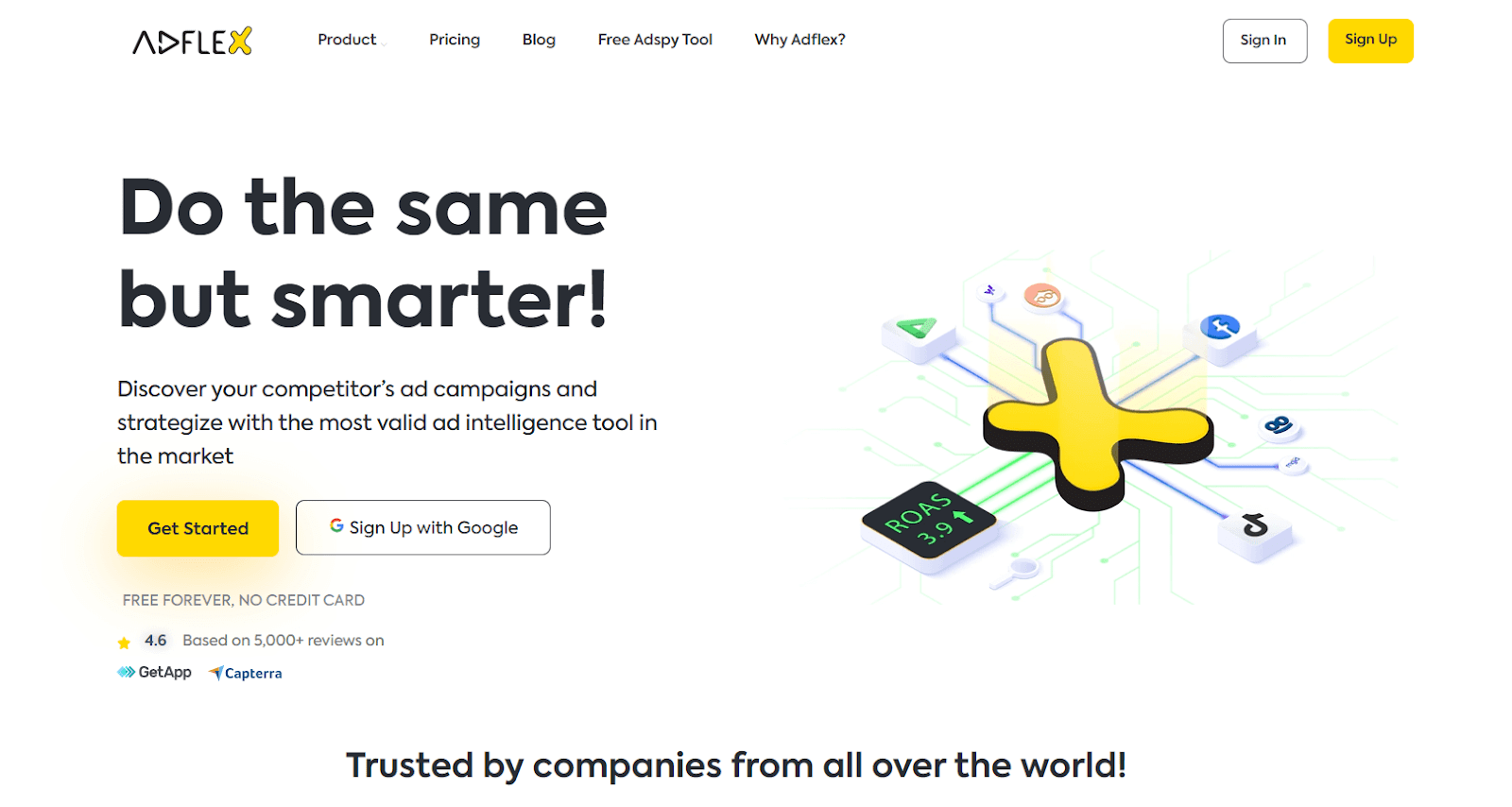
AdFlex covers Meta, TikTok, Google Display, YouTube, Pinterest, Reddit, X, and native networks. It fits sellers who want cross-platform history and e-commerce research in one dashboard. Bookmarks, competitor follows, and launch alerts support an ongoing watchlist.
The free plan includes Meta access and 2,000 credits. Pro costs EUR99 per month with 100,000 monthly credits. Enterprise adds API access. That setup gives a small store a free test before it commits to broader coverage.
The main drawback is that useful depth still depends on credits and the paid plan. A seller monitoring one network can keep the workflow simpler with an official library. I would choose AdFlex when alerts and cross-platform history are the deciding needs.
How often should you check competitor ads?
Check close competitors before each campaign-planning cycle, then sweep the wider category less often. In my stores, a weekly watchlist and monthly category sweep are a practical starting rhythm. Adjust that rhythm to your campaign volume. The close pass catches changes that can shape the next test, while the broad pass finds new entrants and seasonal shifts.
Use this checklist for each close-competitor pass:
- Save ads that appeared since your last check.
- Record any price, bundle, guarantee, or shipping changes.
- Mark unchanged ads that remain active.
- Compare the ad promise with its landing page.
- Write one hypothesis for your own account.
The wider sweep uses the same fields across broader category searches. Keep a simple sheet with the advertiser, platform, first-seen date, and last-seen date. Add the hook, offer, proof, format, landing page, and your proposed test. A screenshot without those fields becomes a pile of inspiration you won't use.
During a launch or holiday push, I add a midweek check when creative changes faster. The wider sweep keeps its usual rhythm unless several new advertisers enter the category at once.
What to look for in competitor ads
A useful ad record captures six signals that explain the creative, audience, response, and staying power. Each signal answers a different question, so a high like count can't replace proof that the offer converts.
Review the signals in this order:
- Content and hook: What stops the viewer and frames the offer?
- Target demographics: Who appears to receive or respond to it?
- Reach and click-through rate: Does attention become a click?
- Engagement: Do reactions show interest, objections, or sharing?
- Conversion signals: Does public evidence point beyond the click?
- Longevity: Has the advertiser kept the creative active?
The first five explain the ad. The sixth helps decide whether it deserves a teardown.
Ad content and hook
The content shows how the product earns attention, while the hook gives the viewer a reason to keep watching. Record the first spoken or written line, the opening visual, the product demonstration, the proof, and the call to action. Those elements form the sequence you can analyze.
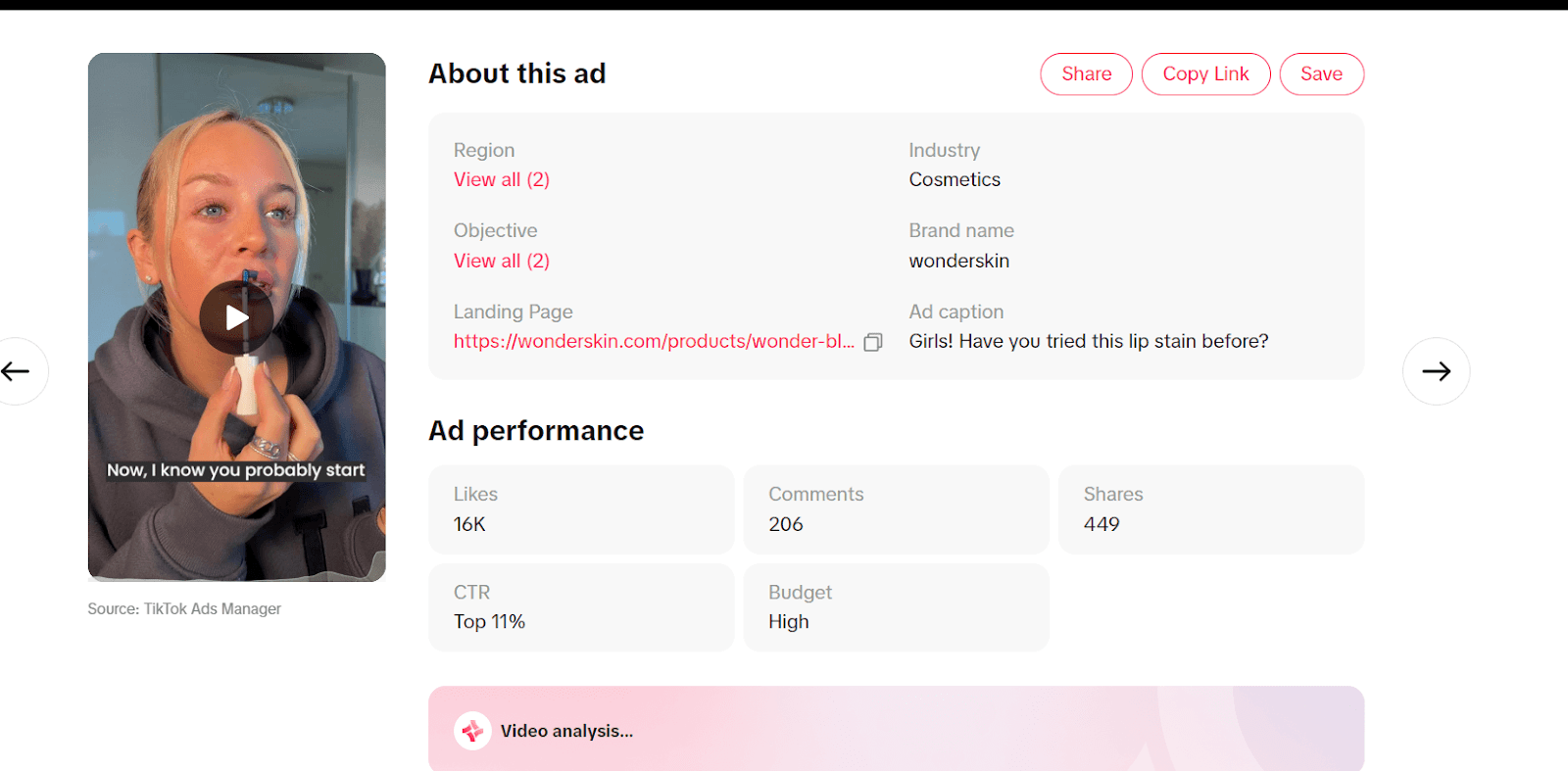
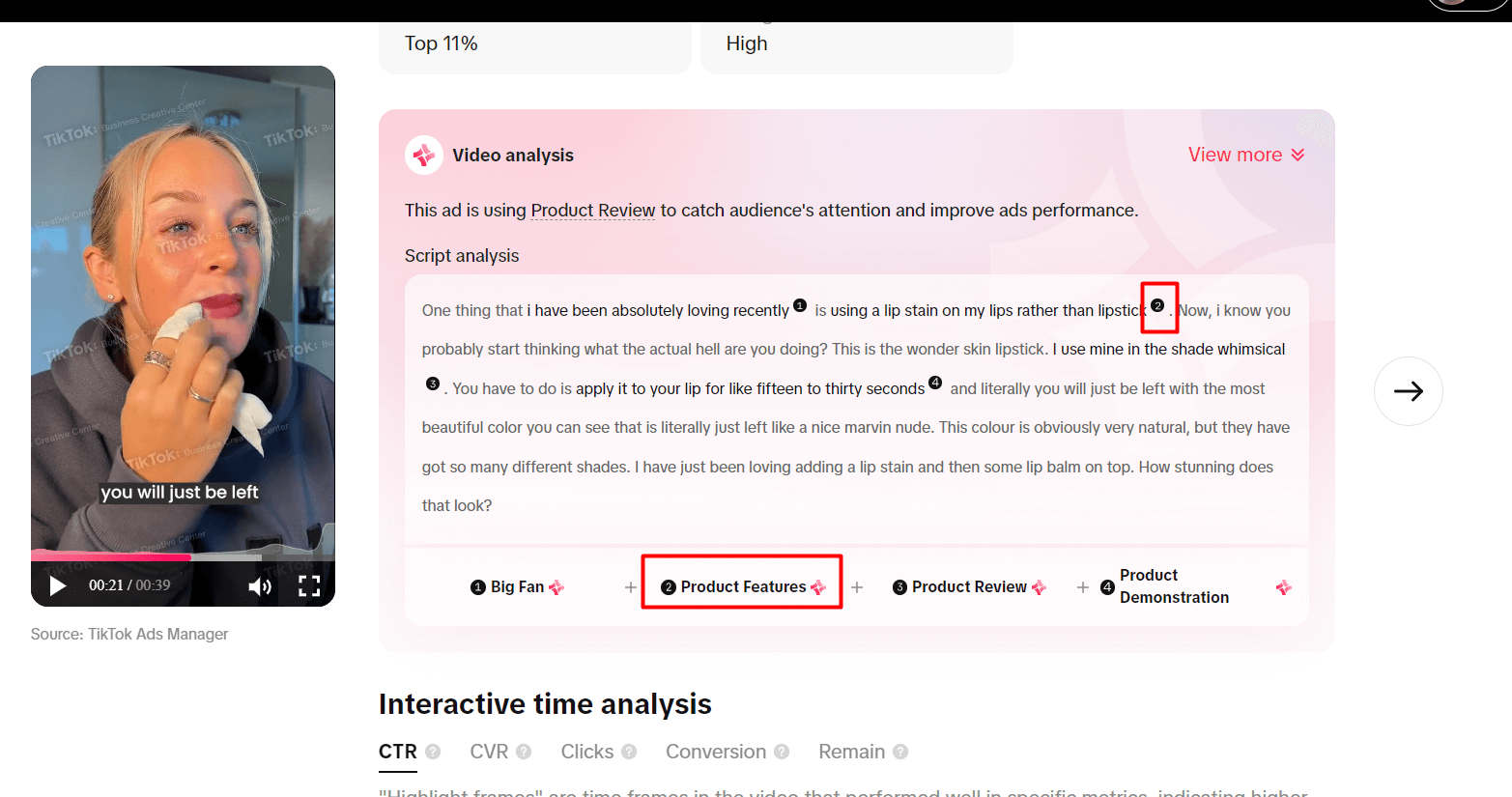
The lipstick ad opens with a direct product question and uses a creator-style demonstration. Its script introduces the lip stain as part of the demonstration instead of reading a feature list. That mechanism matters more than the exact wording because your product needs its own claim and proof.
When I study how clothing ads perform, I use the same test. The first frame and offer must make sense together. A visually strong ad with an unclear product promise gives you only a creative style.
Target demographics
Demographic clues show which locations, ages, or audience groups a competitor chose or reached. Treat them as a lead for your own audience test. A competitor's targeting can reflect convenience, inventory, or an old assumption instead of proven demand.
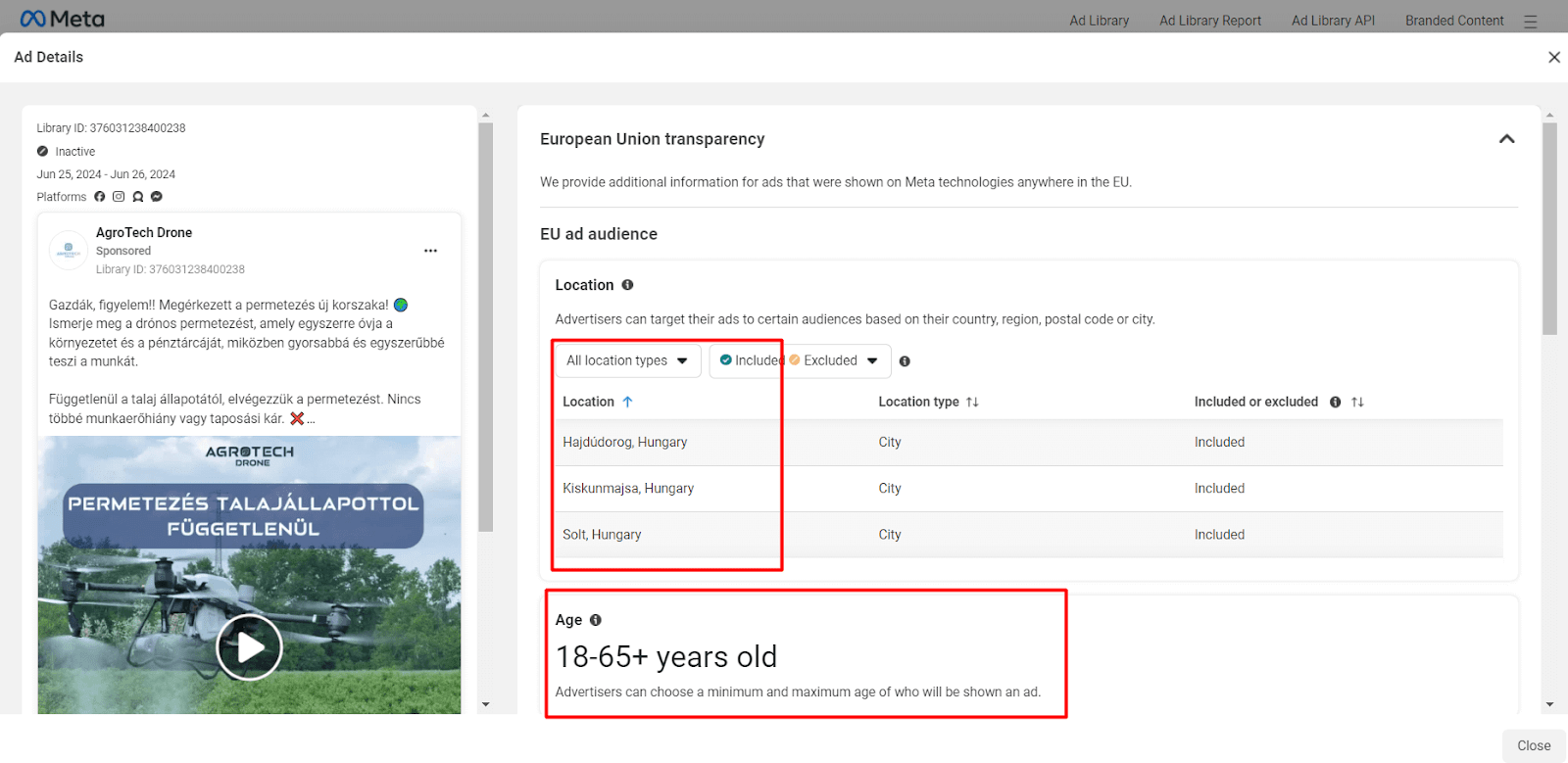
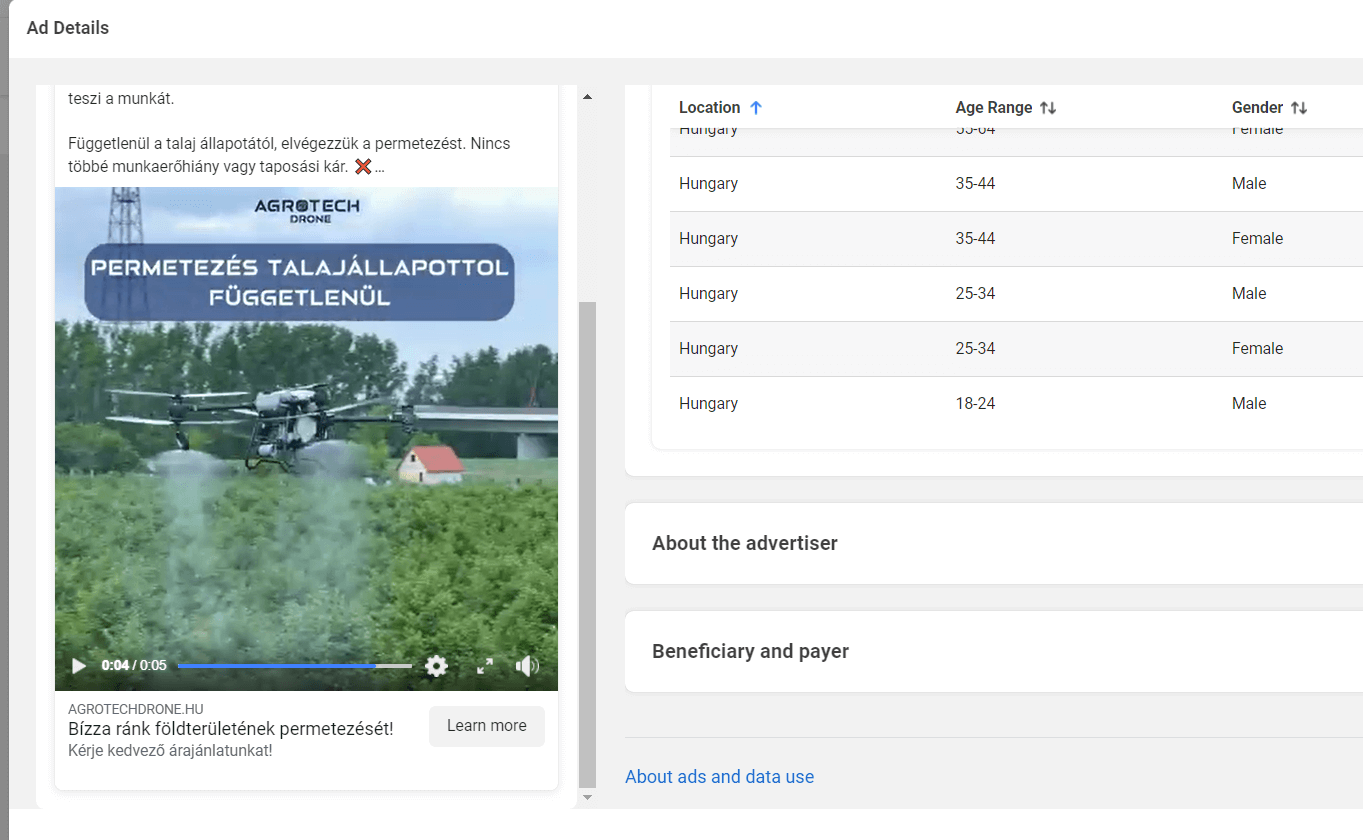
The drone example targeted three Hungarian cities and an 18-to-65 age range. That scope is more useful than a vague note such as "drone buyers." It tells you the market and age span behind the creative.
Record the targeting keywords and geography separately. You can then test which choice mattered.
Reach and click-through rate
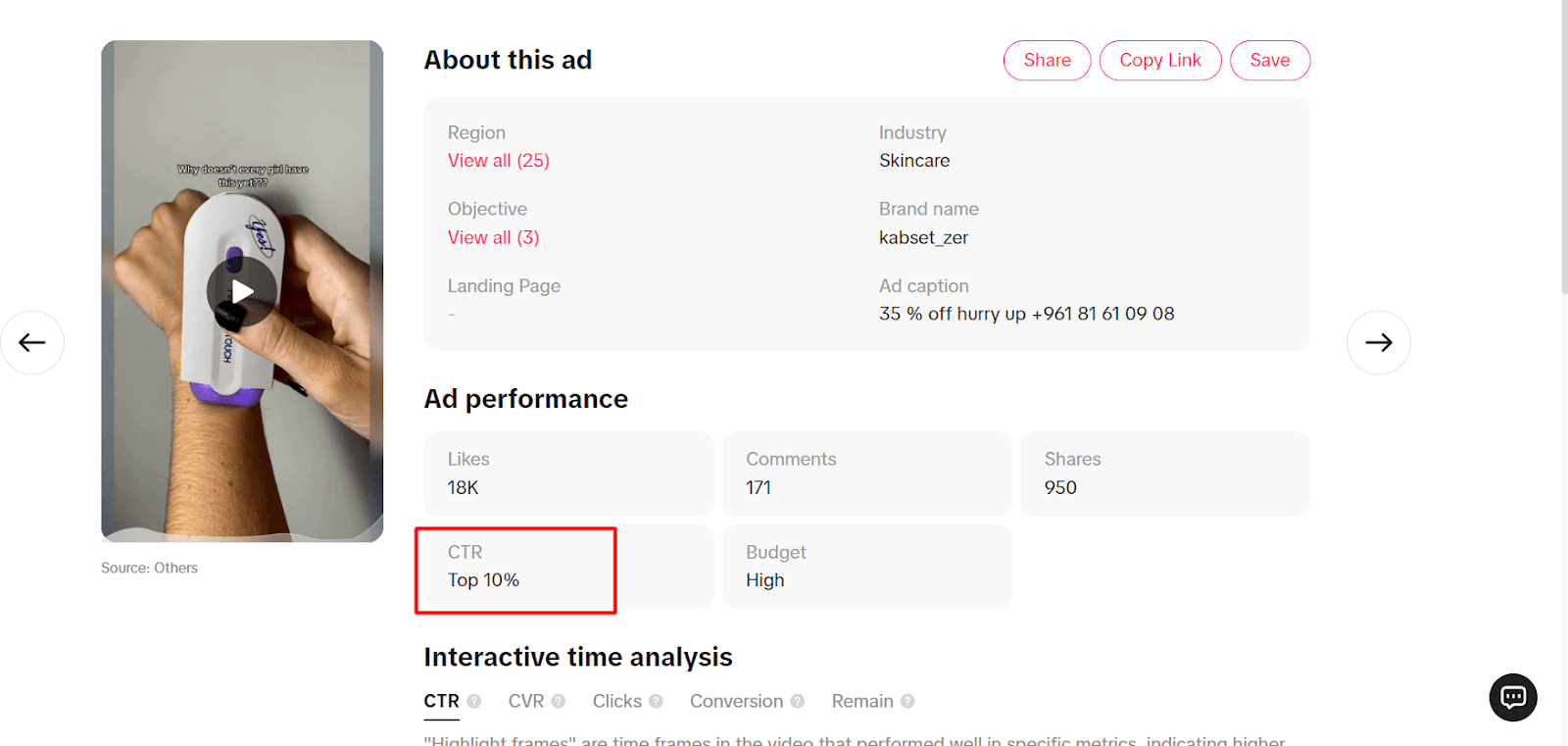
Reach shows how many people saw an ad, while click-through rate shows the share who clicked after seeing it. Reach reflects distribution. Click-through rate gives you a clue about whether the opening, promise, and format persuaded viewers to take the next step.
Read the two together. High reach with weak clicking may mean the advertiser found an audience but missed the message. Strong clicking with limited reach may mean the hook works in a narrow audience. You still can't infer sales from the click alone.
Engagement metrics
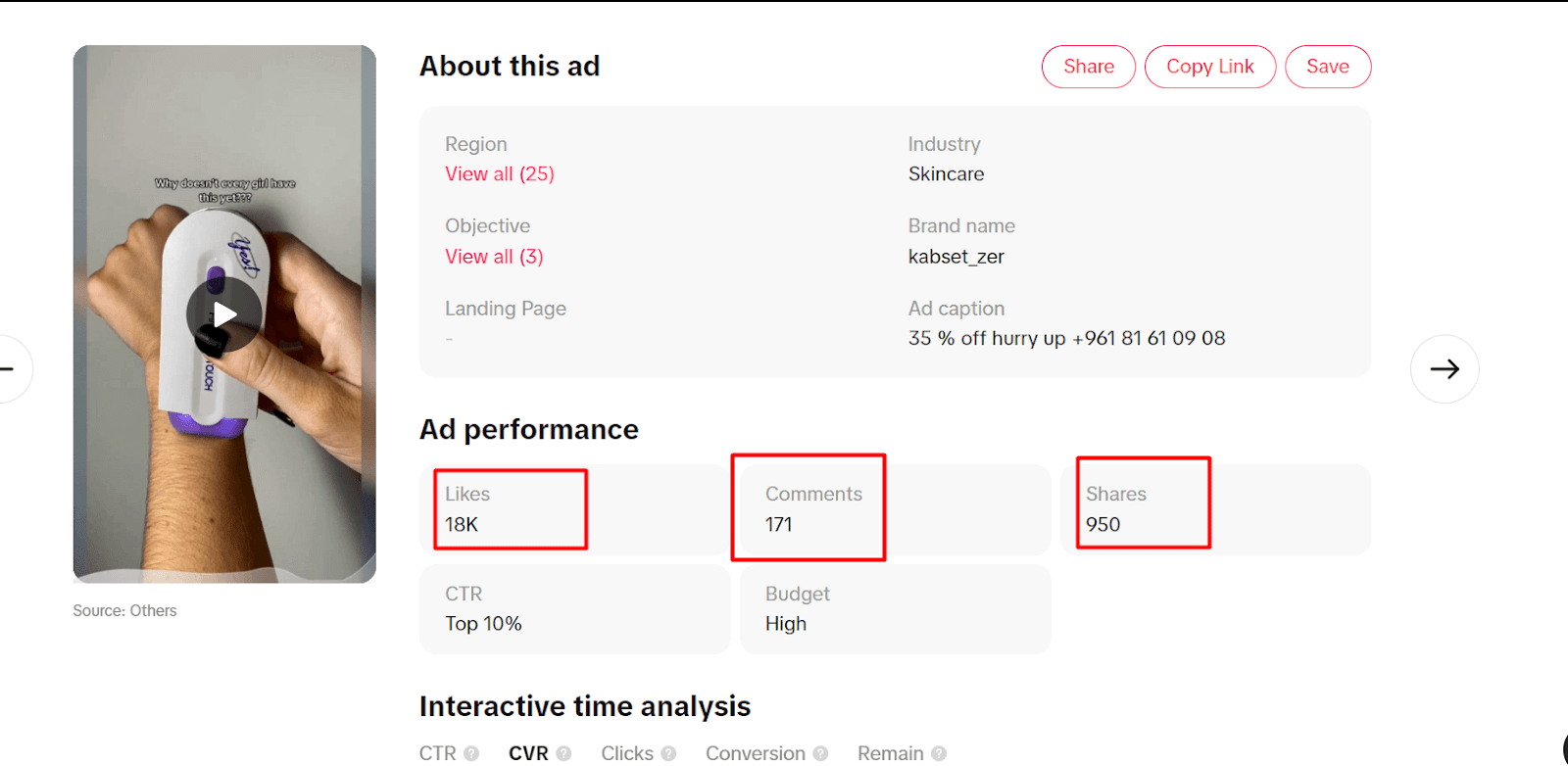
Likes, comments, and shares reveal different kinds of response, so read the mix rather than one total. Comments can expose objections or questions. Shares can show that viewers find the creative useful or entertaining. Likes are the weakest signal because they require little effort.
Engagement can still mislead when a controversial ad earns comments from people who will never buy. Open the comment sample, group repeated themes, and note whether people ask about price, shipping, product use, or availability. Those questions can improve your landing page even when you reject the ad's hook.
Conversion signals
Conversion signals connect attention to a chosen action. They include a purchase, download, follow, or signup. Public libraries rarely show a competitor's exact profitable sales, so use visible conversion metrics, product-sales data, and landing-page continuity as separate clues.
A high click-through rate followed by weak conversion can point to a mismatch between the ad promise and landing page. A product with sales activity and several active variants gives you a stronger reason to study the creative. Neither signal proves your version will work.
How long an ad has run
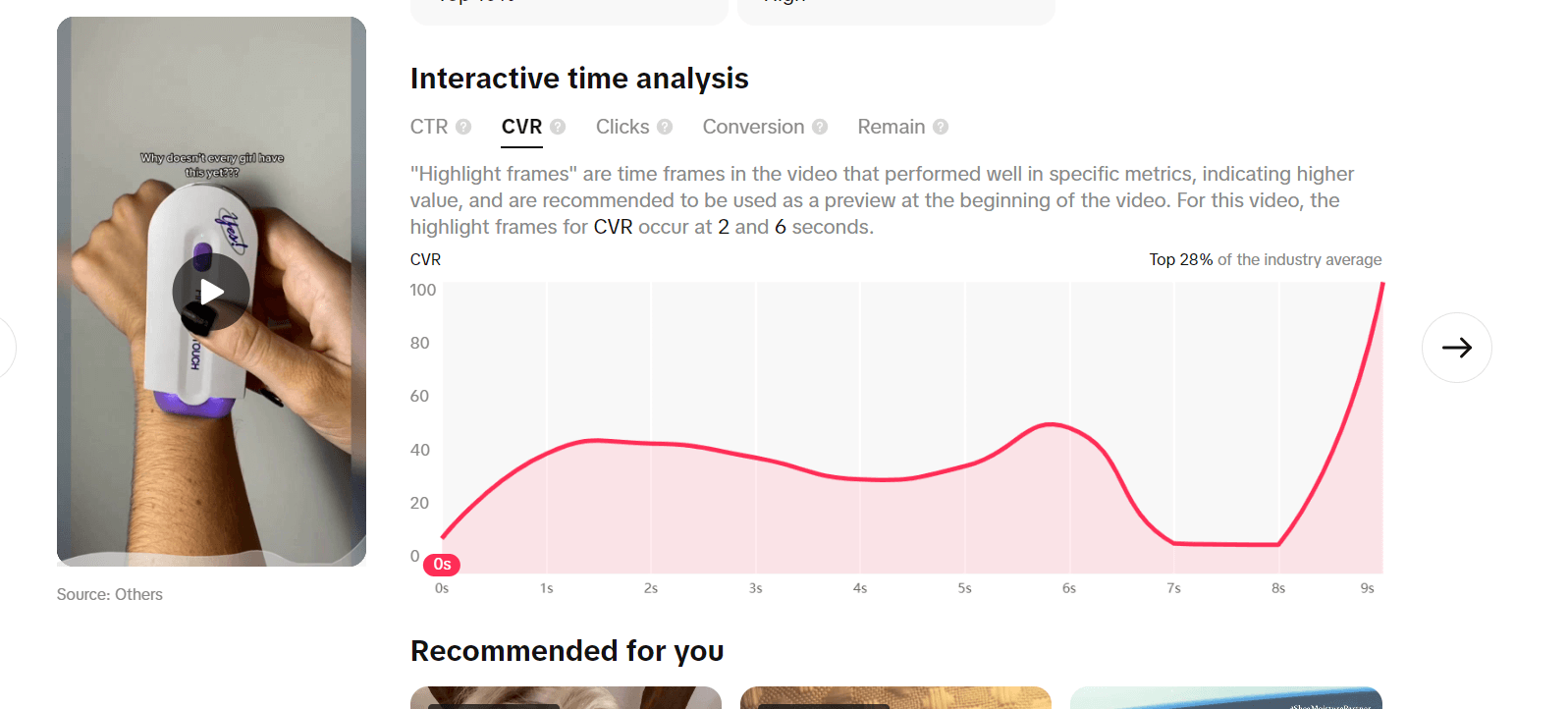
An ad that outlasts a competitor's usual creative cycle is worth a closer look, though it doesn't prove profit. Record first-seen and last-seen dates across your own checks. Compare the ad with other creative from the same advertiser instead of relying on a universal day count.
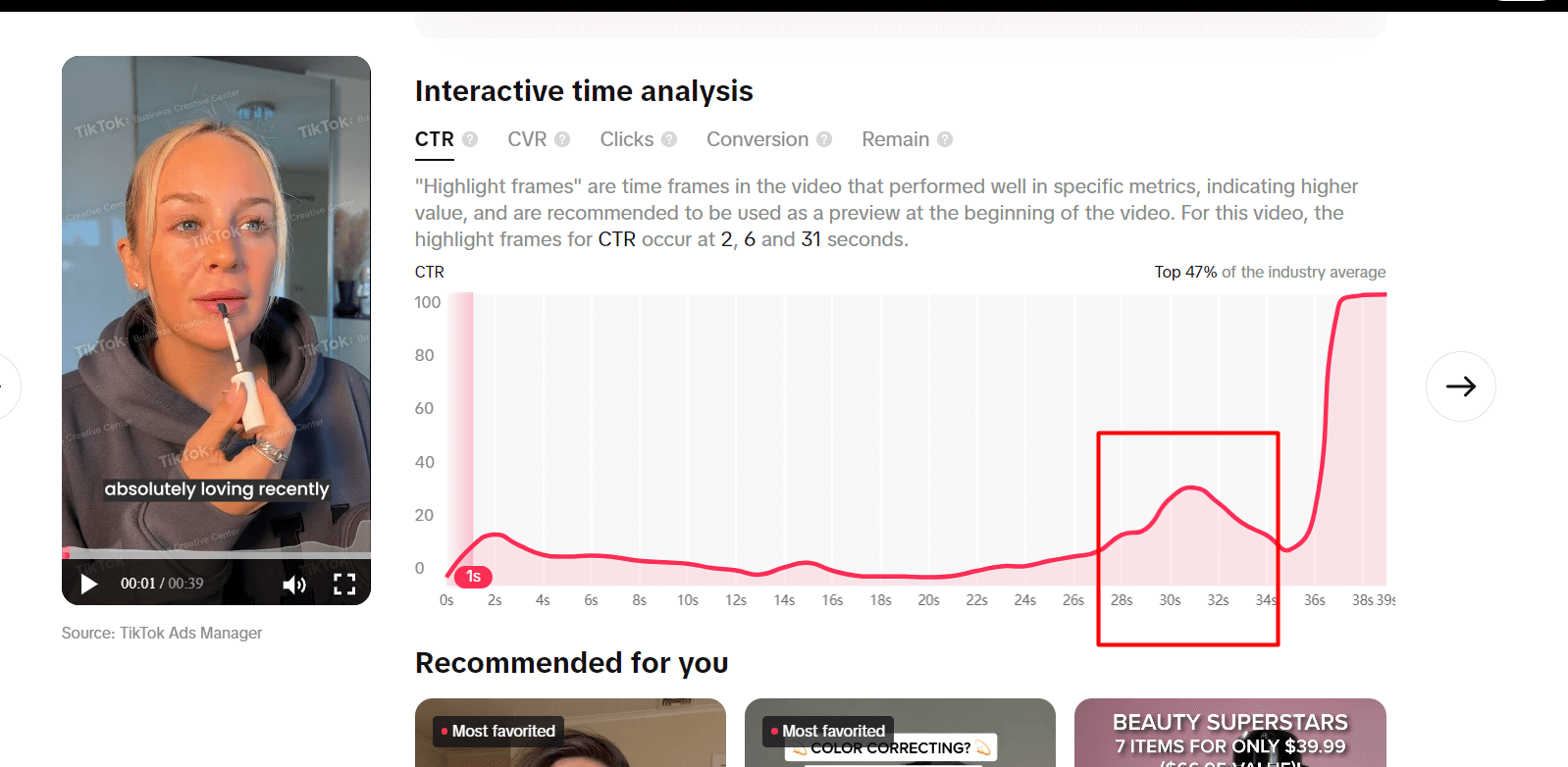
Pair duration with continuing engagement or a separate product-sales signal. The lipstick video's click graph rises at 31 seconds, after the natural-color claim. That gives you a specific moment to inspect. Duration tells you to look closer, while the graph suggests what viewers responded to.
Large advertisers can break this proxy by rotating many short tests on purpose. A short run may mean active testing rather than failure. A large budget can also keep a long-running ad alive. I use longevity only to filter the teardown queue.
The 4-step ad teardown
The 4-Step Ad Teardown moves from evidence to pattern, original execution, and a measured test. Each step needs the prior output. Rewriting too early encourages a close copy. Testing without a baseline leaves you with no useful verdict.
The four steps run in order:
- Confirm: Select an ad with enough evidence to study.
- Extract: Name the structural pattern beneath its words and visuals.
- Rewrite: Apply that pattern to your product's true advantage.
- Test: Compare the new ad with your current control.
Use the rail as your working order, then complete each decision below.
Confirm the ad is worth studying
Confirm the ad has a longevity, engagement, or product-sales signal before you analyze its creative. Start with an active ad, note its first-seen date, and record the public response. Add a separate product or store signal when your tool provides one.
The lipstick ad earned 16,000 likes and showed a clear click spike within the video. The drone ad had weaker creative, but its targeting and reach data still made it useful for an audience lesson. These ads answer different questions, so they shouldn't enter the teardown for the same reason.
Extract the pattern
Extract the ad's hook, proof, offer, and sequence without keeping its product-specific wording or design. The lipstick example uses a question hook and creator demonstration. It then shows a natural-looking result and a simple product distinction. The useful pattern is demonstration-led proof.
Write the pattern as a neutral sentence. For the lipstick ad, use this version: "Ask about a familiar frustration. Demonstrate the alternative and show the result in the same video." For the drone, try this: "Show the product in use.
Match the creative to a narrow geographic audience." I prefer plain descriptions because they expose a rewrite that stays too close.
Rewrite it for your product
Rewrite the structural pattern with your own customer problem, product proof, footage, and claim. A stain-resistant tablecloth could use the lipstick pattern. Ask about a common spill, pour coffee on the fabric, wipe it clean, and show the dry surface.
The sequence transfers, while the words and demonstration remain original.
Match the ad to a true product advantage. If the tablecloth still stains after several minutes, don't promise complete stain resistance. Use our Facebook ad account guide to place the new concept inside a controlled test. Keep the audience and offer steady while you change the creative.
Test against your baseline
Test the rewritten ad against your current control while keeping the audience, offer, placement, and measurement window steady. Define the winning metric before launch. A traffic test might use click-through rate, while a sales test should use cost per purchase and return on ad spend.
The competitor pattern is a hypothesis, so your own result decides whether it stays. Use the same spend rule for both creatives. Stop them under the same condition and record the outcome beside the source pattern. Set a target return on ad spend before launch so a higher click rate doesn't hide weak economics.
I recommend keeping the pattern only when it beats the control on the metric tied to your campaign goal. A copied surface detail can look familiar and still hurt performance because your product, proof, and audience differ.
How to use Dropship.io for ad monitoring
Dropship.io connects competitor ad research with store, product, advertiser, and sales signals in one workflow.
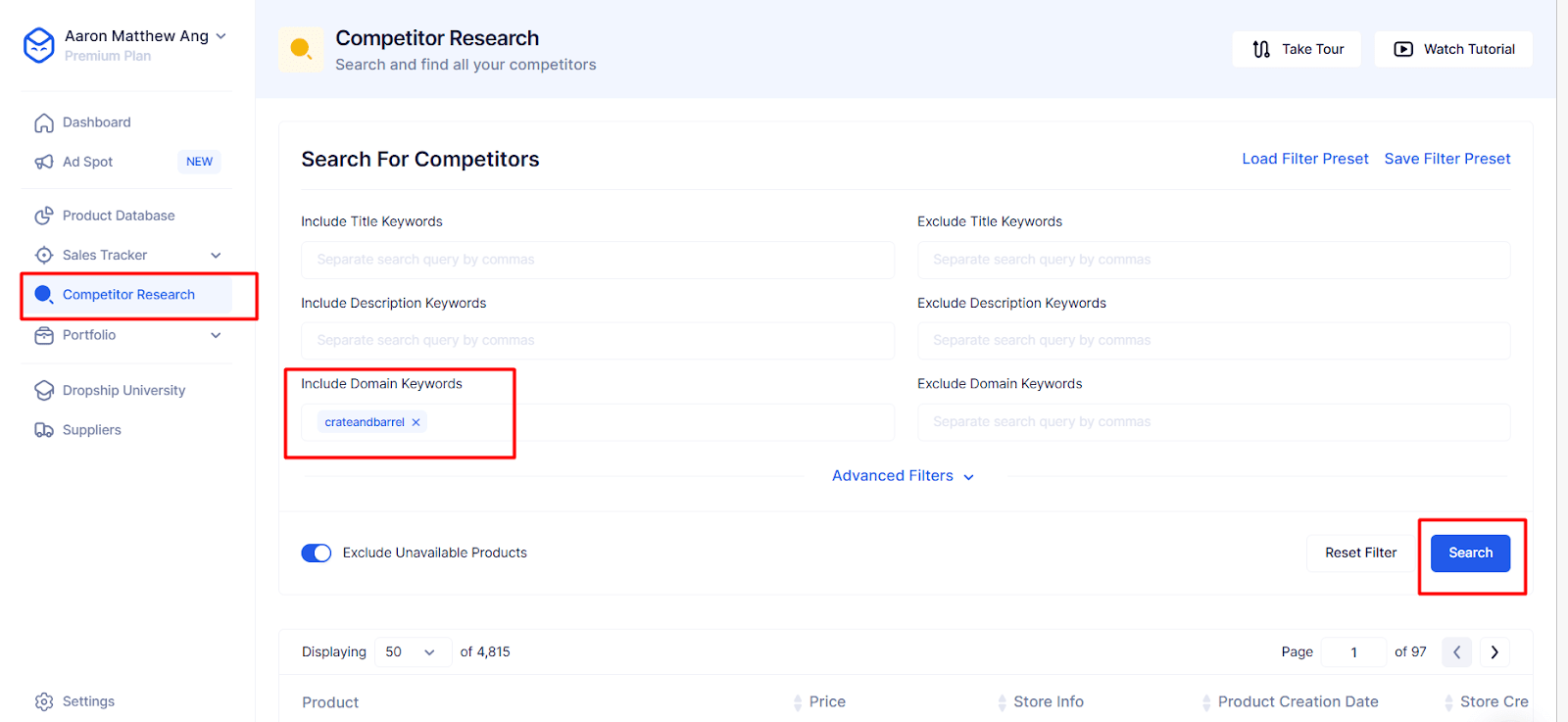
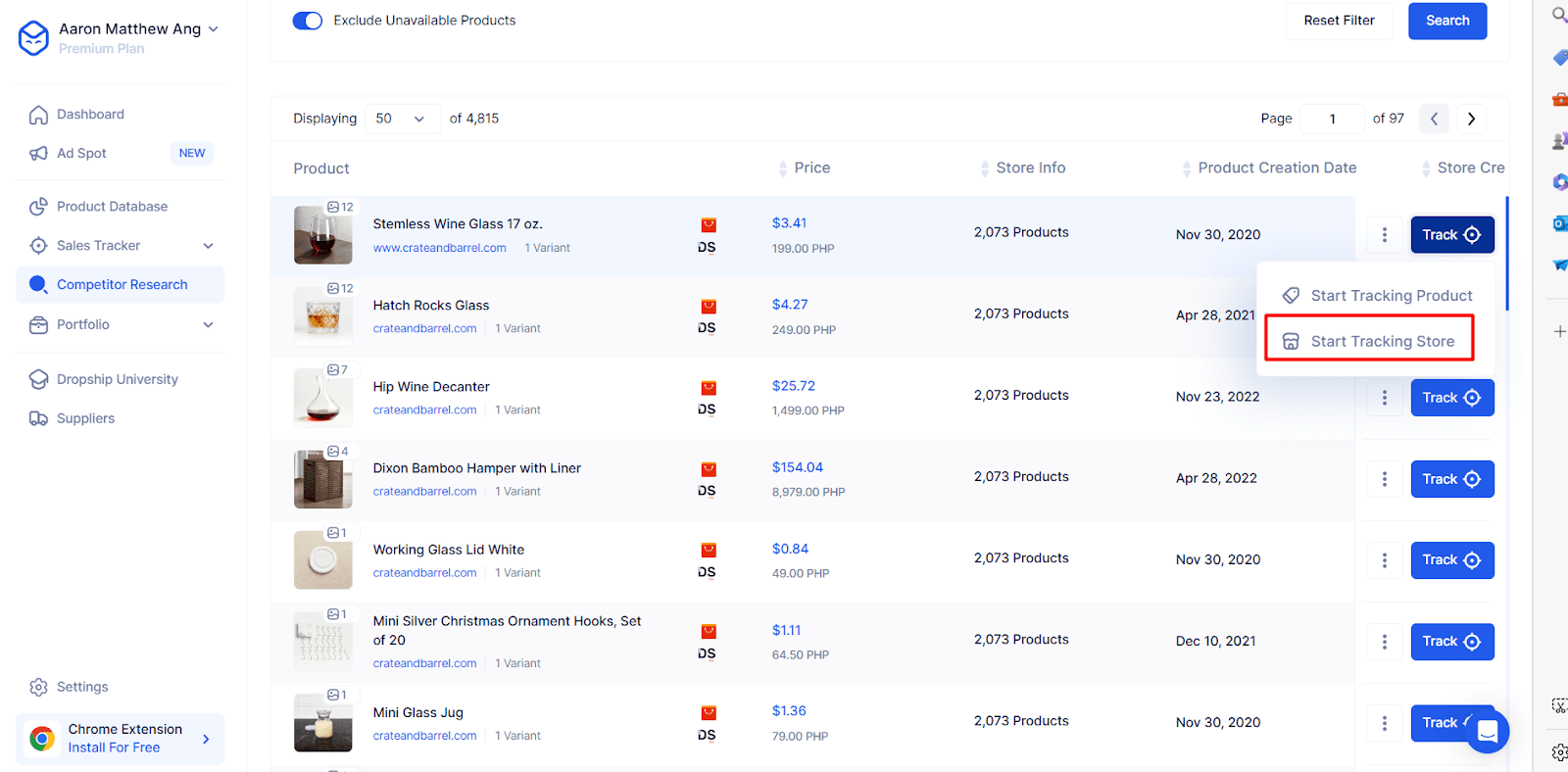
Search for a competitor, open its store record, add it to Sales Tracker, and review the available ad library. Then compare active creative with product and store activity before choosing an ad to tear down.
Use the workflow in this order:
- Find the store: Search Competitor Research by domain or keyword.
- Track the store: Add the result to Sales Tracker.
- Open its ads: Review creative, copy, reach, and advertiser details.
- Cross-check demand: Compare the ad with tracked product or store sales.
- Record a hypothesis: Save the pattern and your proposed original test.
This process is strongest when the competitor and product appear in Dropship.io's tracked database. A seller outside that coverage still needs a general spy tool or official platform library.
Read the store signal before choosing an ad
Store activity can strengthen the case for studying an ad, but it can't prove that the creative caused the sales. Treat Sales Tracker as a separate demand signal and keep the ad's own duration and engagement in view.
If you're new to execution, our guide to running Facebook ads explains how to launch the resulting test.
How we sourced this guide
Tool comparisons use each product's current official feature and pricing pages. The legal answer uses this six-source record:
- Copyright statute for copyright scope.
- Copyright Office guidance for the idea-expression boundary.
- Trademark statute for trademark scope.
- USPTO guidance for confusion risk.
- Current scope authority for the law's status.
- Secondary advertising analysis for added context.
FAQ
These answers cover the legal, account, and scope decisions that remain after you choose a tool and monitoring cadence.
Is it legal to copy a competitor's ad?
US copyright law leaves ideas and methods open but may protect an ad's original words, graphics, and video. Copied brand elements can create trademark risk, so use new expression and get legal advice for a close or high-value campaign.
Should I monitor indirect competitors?
Yes, but keep them in the broader category sweep rather than the close watchlist. An indirect competitor is useful when it targets the same audience with a different product, offer, or creative format.
Can an ad spy tool get my account banned?
Researching public ads in a separate tool doesn't change your ad account's policy duties. Your account can still face enforcement for the creative, claims, targeting, landing page, or other campaign choices you publish.
What should trigger a new ad test?
Start a test when a repeated competitor pattern gives you a clear hypothesis for your own hook, proof, offer, or format. Require your own customer evidence and define the winning metric before you launch it.


